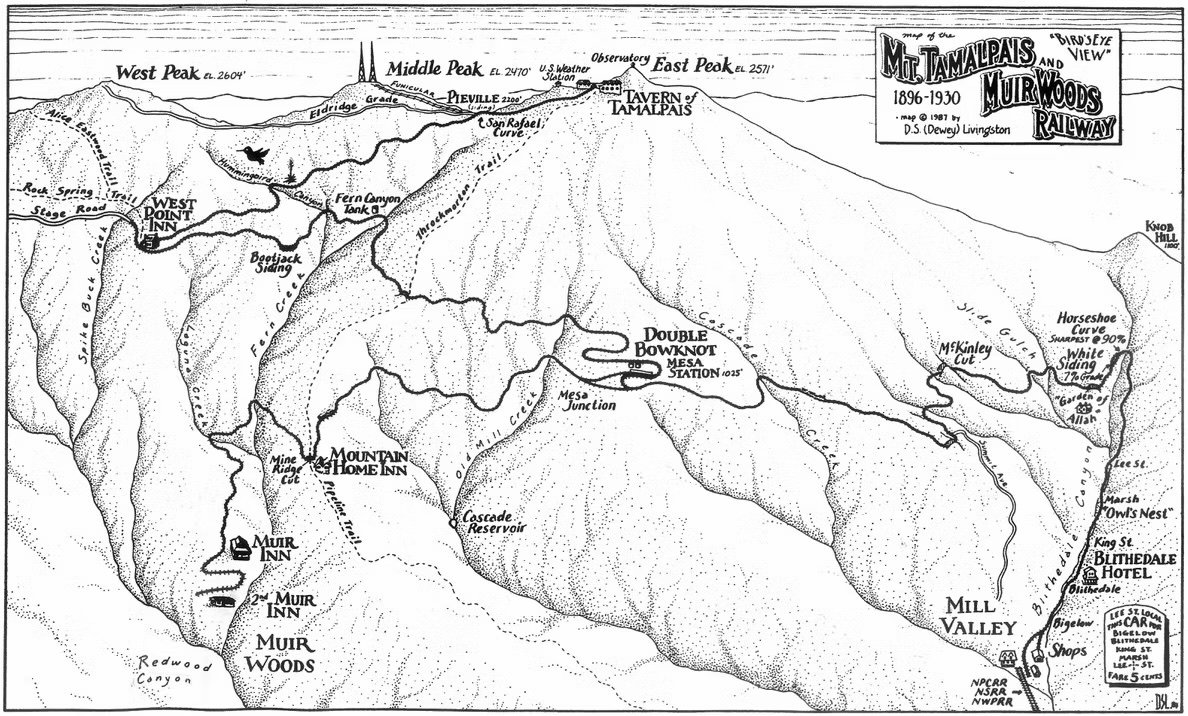
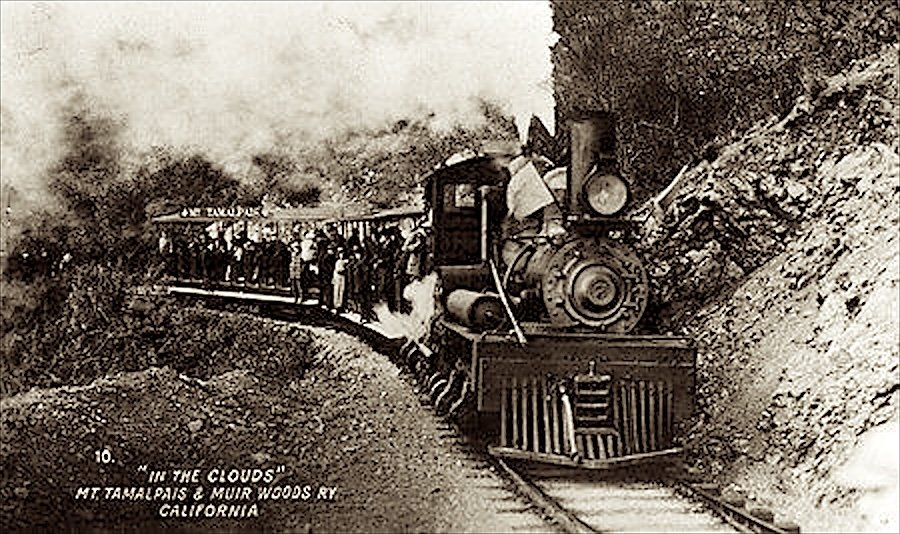
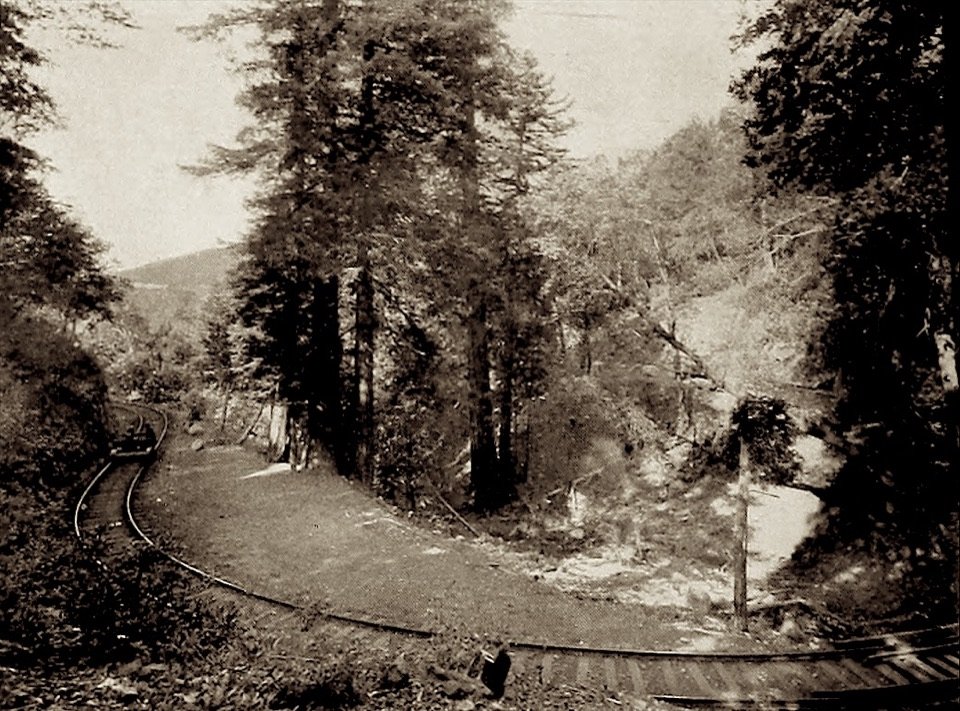
Billed as “the Crookedest Railroad in the World,” this scenic railway climbed 8.19 miles from Mill Valley to the East Peak of Mount Tamalpais, with a 2.5-mile branch down to Muir Woods. Planned as an electric trolley, it was worked instead by geared steam locomotives, winding through the hills to a mountaintop tavern with views across the whole Bay.
It was the idea of Louis L. Janes of the Tamalpais Land & Water Company, Mill Valley’s first town clerk, with Sidney B. Cushing as president. Construction began on February 5, 1896 - A. E. Kent gave the right-of-way through Corte Madera Canyon in exchange for $10,000 in stock (about $370,000 today). A fire in 1929, and cars that could finally drive to the summit, brought the line to an end.
It was built in six months by crews averaging 200 men, mostly European immigrants, working by hand with picks, shovels, wheelbarrows and blasting powder - for about $1.75 a ten-hour day (about $65 today). The line cost about $55,000 (some $2 million today), plus $80,000 (about $3 million) for equipment: 57-pound steel rails on redwood ties, 22 trestles and 281 curves, at an average grade of 5% and 7% at the steepest, just below the summit.
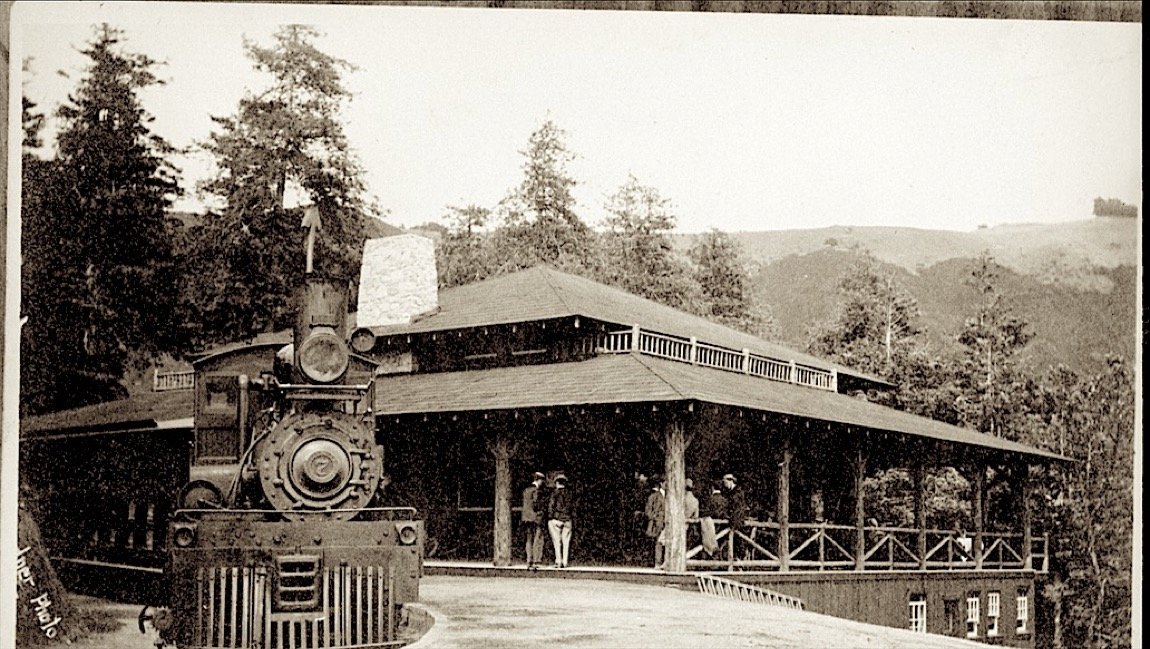
The tracks began at a depot at 87 Throckmorton Avenue in Mill Valley, about 70 feet above sea level - a far grander, Victorian building than the mission-style depot (now a bookstore and café) that stands there today. Trains headed north through town past a water tank and shed at Lovell Avenue; the engine house stood at Corte Madera Avenue and Alcatraz Place.
Most riders started in San Francisco. They crossed the bay by ferry to Sausalito and rode the North Pacific Coast Railroad - a 3-foot narrow-gauge line - to its Mill Valley station, opened in 1889 as Eastland, where the mountain train waited at the same depot.
That connection was remarkably modern. In August 1903 the line from Sausalito - by then the North Shore Railroad - began running standard-gauge electric cars on a 600-volt third rail: the first steam railroad in the United States electrified to run more efficiently rather than to cut smoke, and its methods were later used for New York’s Grand Central Terminal and subways. From 1907 it was part of the Northwestern Pacific, and the last passenger train left Mill Valley for Sausalito on September 30, 1940.
Most riders started in San Francisco: they crossed the bay by ferry to Sausalito and took the train to Mill Valley station - opened in 1889 as Eastland - where the mountain train waited at the same depot.
That connection was remarkably advanced. On August 21, 1903 the old narrow-gauge North Pacific Coast line, rebuilt as the North Shore Railroad, began running standard-gauge electric trains between Sausalito and Mill Valley on a 550-volt third rail - California’s first third-rail electrification, with an alternating-current signal system so effective that New York City’s subway signals were based on it. From 1907 these became the Northwestern Pacific interurban lines, which ran until February 28, 1941.
Not everyone wanted it. In February 1896 neighbours on Corte Madera Avenue, angry at the trees being cut, defended their land with shotguns, and a committee led by George Marsh, M. M. O’Shaughnessy and Maurice Windmiller won an injunction. The railway quickly won in court and put 300 men to work through the night by the light of bonfires. The objectors were given stock - and George Marsh got his own station.
The last spike was driven on August 18, 1896. Four days later the first passenger train, carrying Mill Valley residents, climbed to the summit; a press train followed on the 26th, and the grand opening was August 27. The climb first took 90 minutes - 70 by the end of the year - and the trip down 50. A return ticket cost $1.00 from Mill Valley (about $37 today), or $1.40 from San Francisco (about $52), and 23,000 people rode in the first year.
Leaving the depot, a flagman stopped the traffic as the train crossed Throckmorton and squeezed through a narrow “slot” between the buildings opposite - you can still see the gap in the rooflines. The railway’s first ticket office stood where The Store is today.
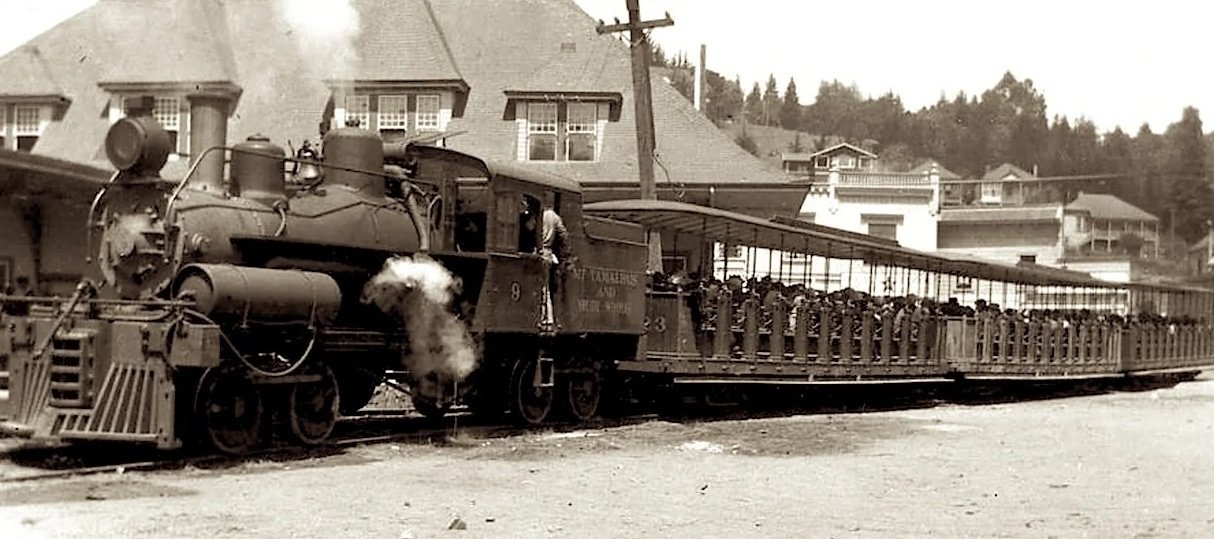
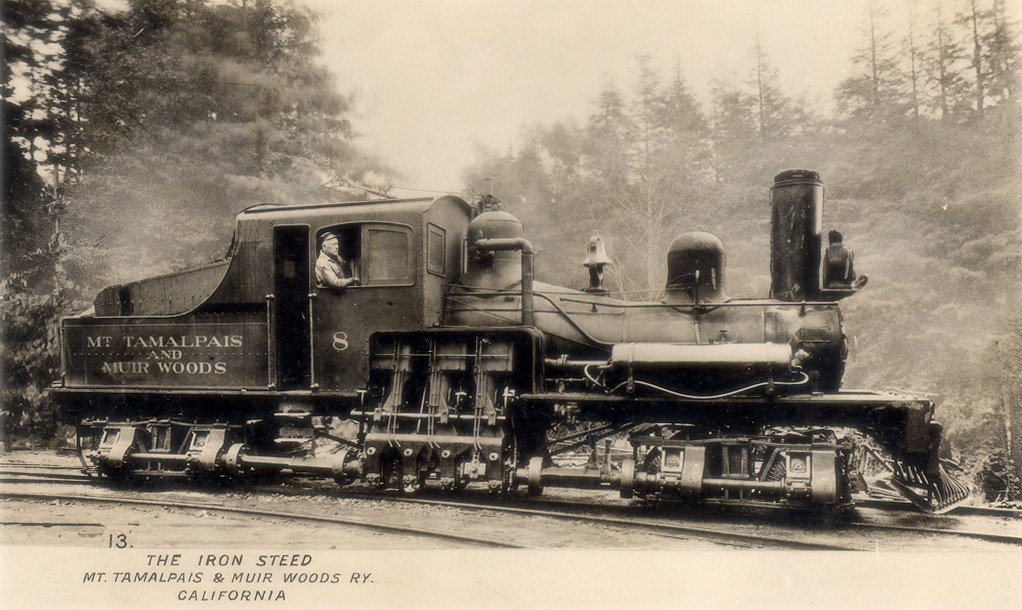
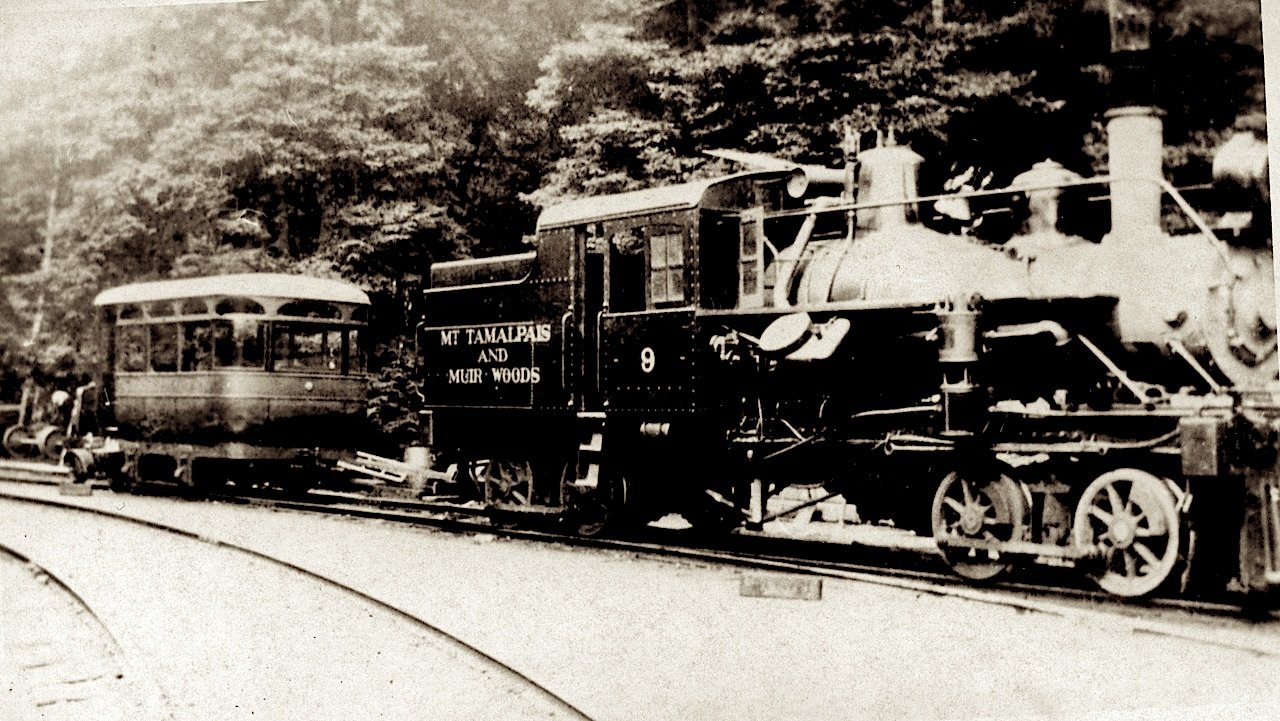
Engine No. 9 at the Mill Valley depot, 1923“The Iron Steed”: Shay engine No. 8 outside the railway’s shops in Blithedale Canyon - postcard, 1926 · public domain, via Wikimedia Commons
Along the creek
Past the Blithedale Hotel
From the depot to King Street the grade followed the Arroyo Corte Madera del Presidio, the stream that twists through Mill Valley between Blithedale and Corte Madera Avenues, and the tracks ran north along it past the Blithedale Hotel.
Engines took on water at a tower at Corte Madera and Lovell, and slept in the engine house and machine shops in what is now Miller Grove (a city park since 1946). The gravity cars were built there, the invention of master mechanic - later superintendent - Bill Thomas.
Through the canyon the line crossed the creek seven times. The first bridge, rebuilt in 1912, still survives behind a fence on Corte Madera Avenue, the steel supports of the third remain at 336 Corte Madera, and stone abutments mark the fourth and fifth at the foot of Marsh Drive. Little stops served the houses and hotels along the way - Redwood Lodge, the Blithedale Hotel, King Street, the Abbey Hotel, and Marsh Station, whose seats were made of madrone branches.
The canyon was a summer resort. Mill Valley became a favourite vacation spot for San Francisco families once the Blithedale Hotel opened in 1879, and at least four hotels stood in the canyon in the late 1800s and early 1900s. Every one ran horse-drawn “buses” to meet the trains at the depot - a four-horse bus for the Blithedale, two horses for the rest.
Mary Cullen’s three-storey Eastland Hotel, opened in 1891 on five acres with cottages and stables, had guests crowding its veranda to watch the first mountain train chug past in 1896; it survived the 1899 fire, reopened in 1900 as the Woodside Inn, and burned in May 1902. Higher up, Miss Abbey Howe’s Abbey Hotel, built about 1900, took 75 guests in twenty buildings - the mountain train stopped at the foot of its street - until the 1929 fire destroyed it.
Dr. John J. Cushing had opened Blithedale as a sanitarium in 1873; after his death in 1879 his widow and son Sidney - the railway’s first president - made it Mill Valley’s first hotel. On the first excursion, August 26, 1896, Sidney Cushing hosted lunch under its redwoods for the directors, friends and press. The hotel closed in 1912.
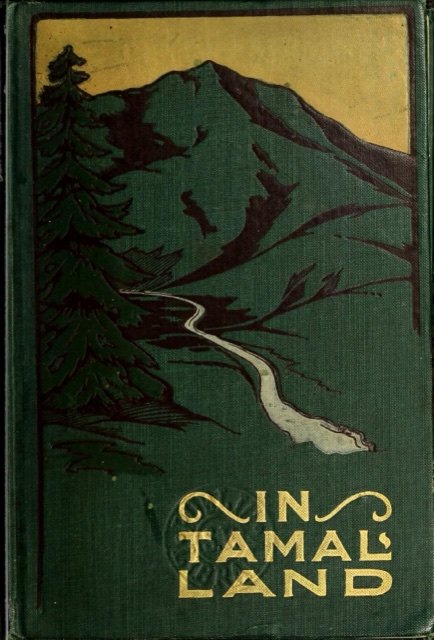
In 1906 Helen Bingham described the train winding “through redwood groves, beside streams and pools,” past the hotel Dr. Cushing had founded years before as a sanitarium.
Visitors at Blithedale“Through the Redwoods” - In Tamal Land, 1906
Shady Lane · 300 ft
Milepost One
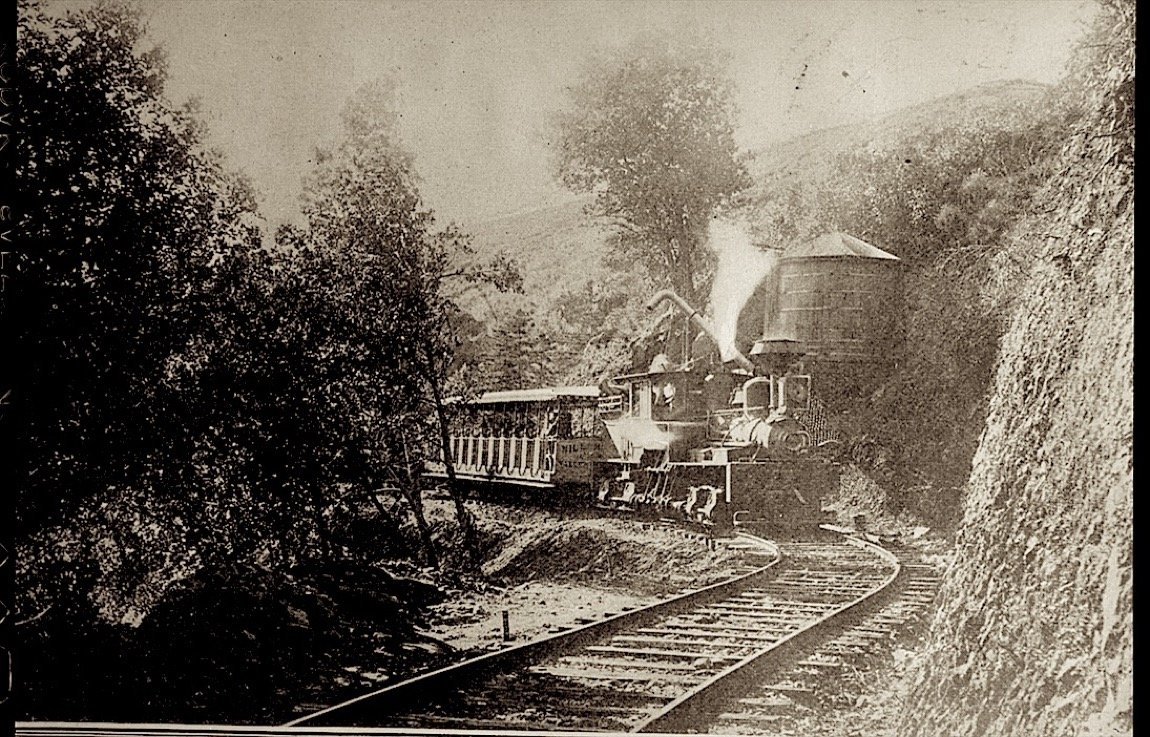
Milepost One stood at 300 feet, about where Shady Lane crosses the stream today. At Lee Street the tracks passed a small station and water tank, then ran another three-quarters of a mile to Horse Shoe Curve, where they crossed the stream one last time and turned southwest.
Lee Street Station had a platform, a water tank and a siding for passing trains. From 1905 to 1927 it was also the end of the Lee Street Local - a one-mile commuter service for canyon residents, 8 minutes to the depot for 5¢ (about $1.75 today; later 10¢, about $3), run by single cars nicknamed “the Black Maria,” “Dinky” and the “Kissel Kar.” Its riders fell from 40,400 in 1921 to 21,812 in 1924.
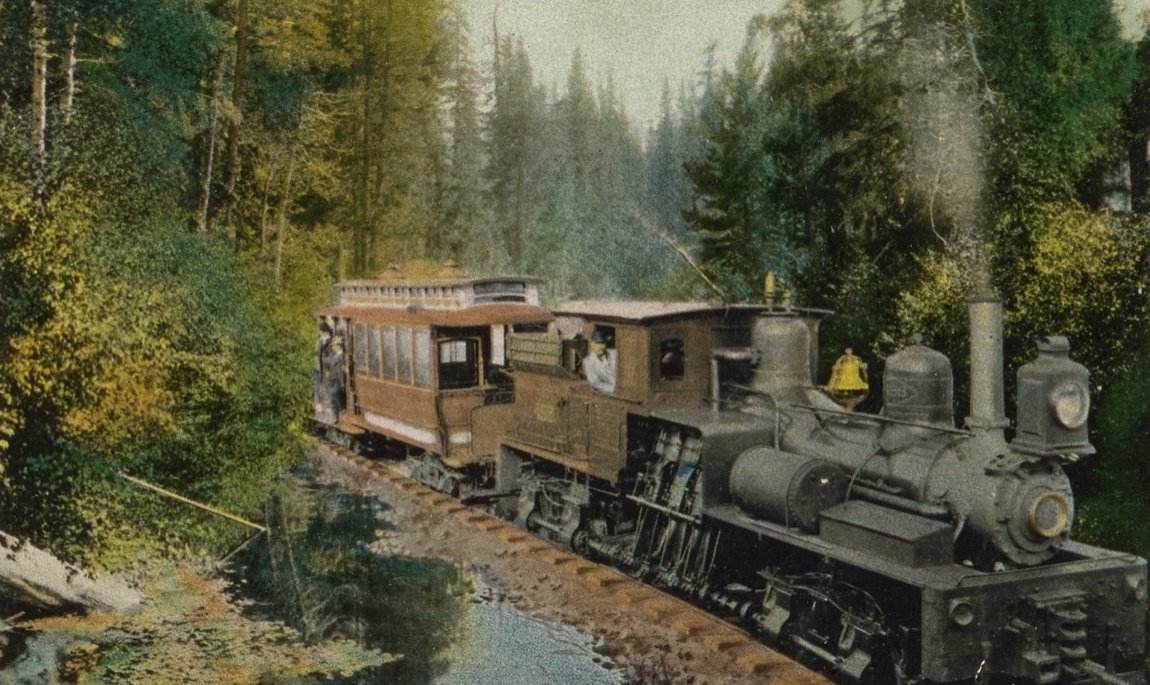
“Mountain train leaving Mill Valley for summit of Mt. Tamalpais” - an early colour postcard · Mill Valley Public Library
A siding · 400 ft
Milepost Two
A siding once stood at Milepost Two, 400 feet up. Heading southwest, the tracks curved almost a dozen more times before reaching Milepost Three.
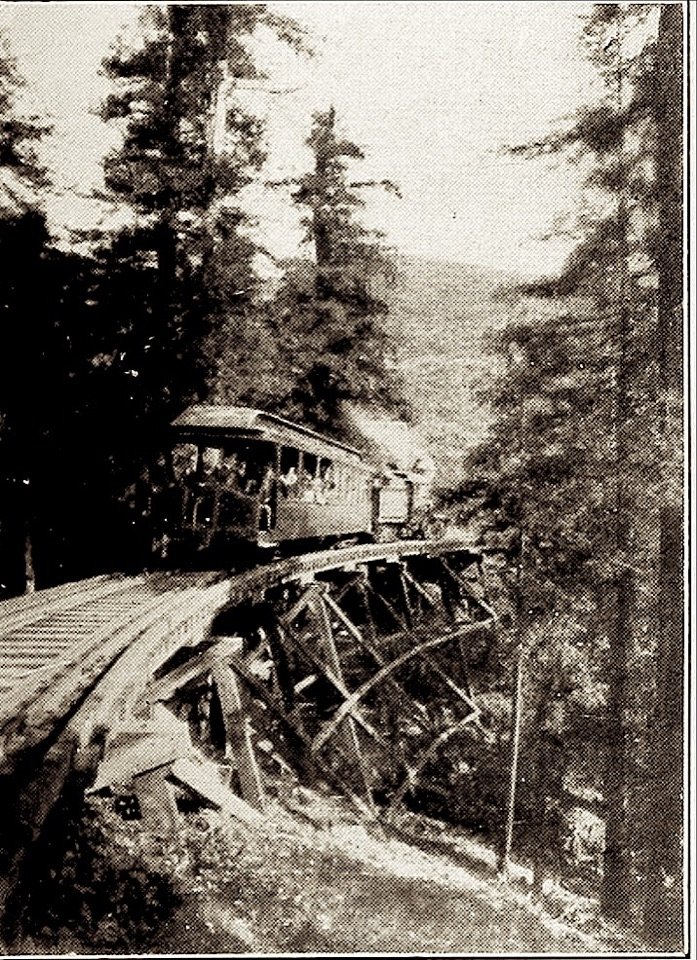
A train on its way down to Mill Valley“The Mountain Train” on a trestle - In Tamal Land, 1906
Fern Canyon · 700 ft
Milepost Three
At 700 feet the line followed what is now Fern Canyon Drive - including a tight curve at Summit Avenue - and wound on through numerous curves to Milepost Four.
As the train climbed, Bingham wrote, chaparral took the place of the redwoods and the towns below appeared “in miniature.”
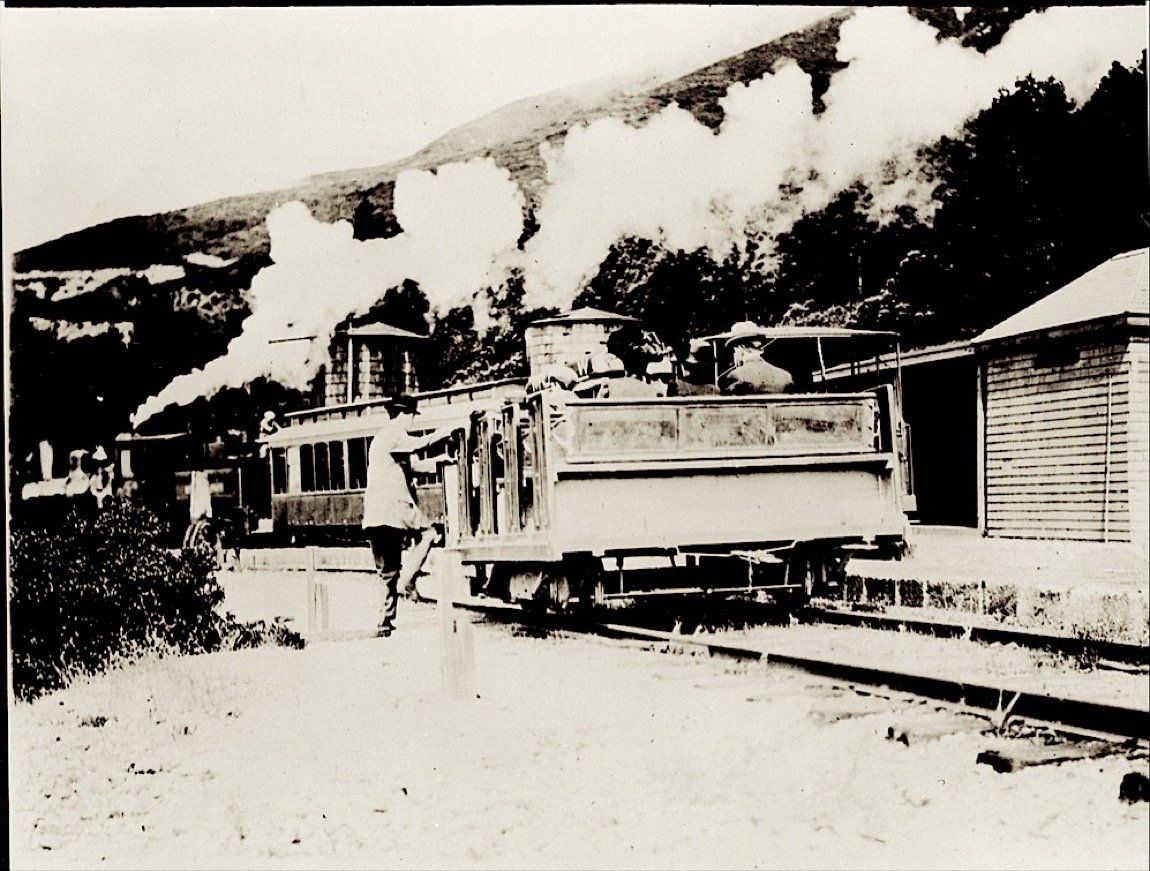
“Turning Innumerable Curves” - In Tamal Land, 1906One of the line’s geared steam locomotivesA train at the Fern Canyon water tank · Mill Valley Public Library
Mesa Junction · 1,000 ft
The Double Bow Knot
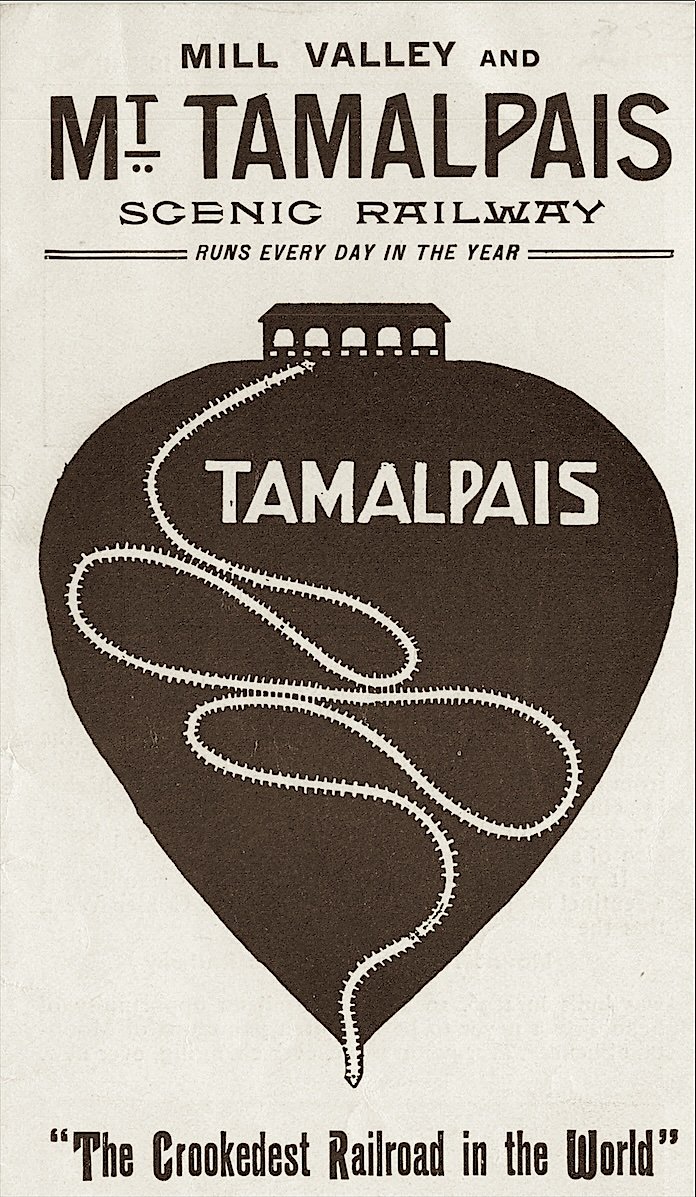
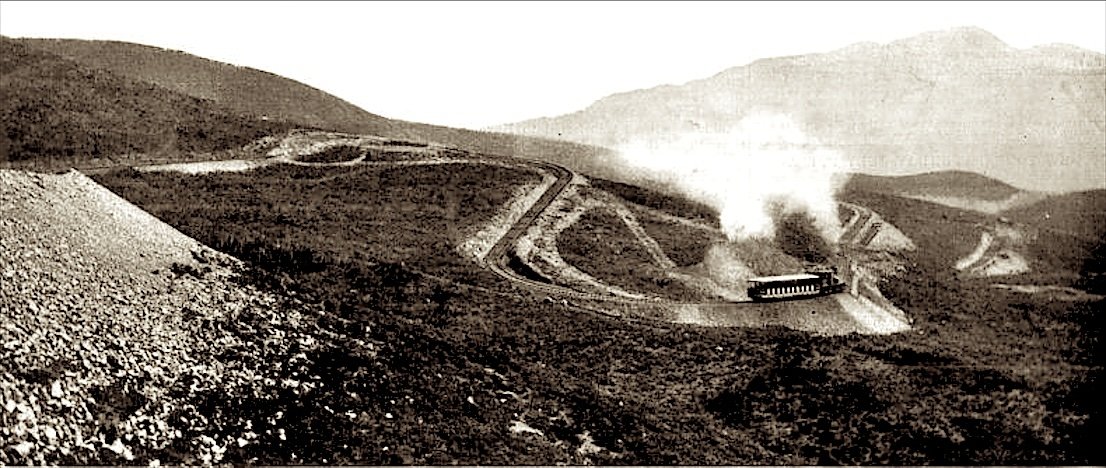
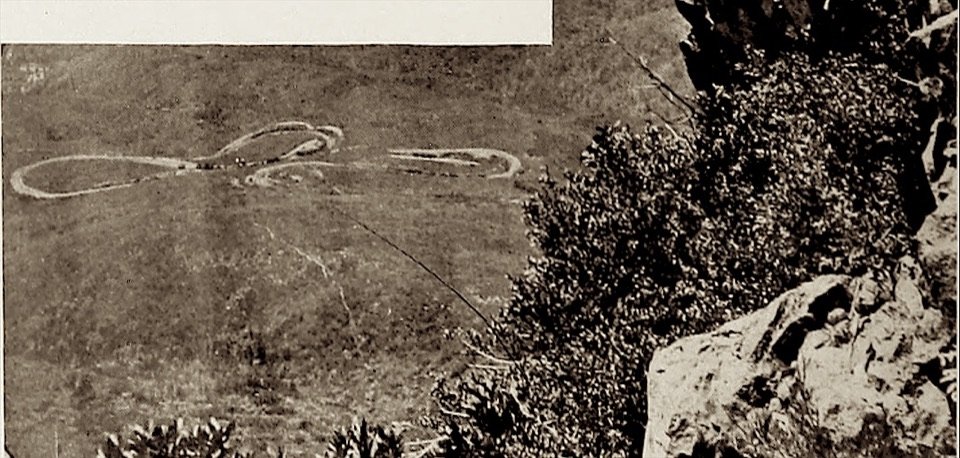
Just beyond Milepost Four, the old roadbed becomes the fire road that hikers can follow all the way to the peak. Mesa Junction, at 1,000 feet, began the famous “Double Bow Knot,” where the track doubled back on itself four times to gain height quickly - passing a small depot, siding and water tank at Mesa Station.
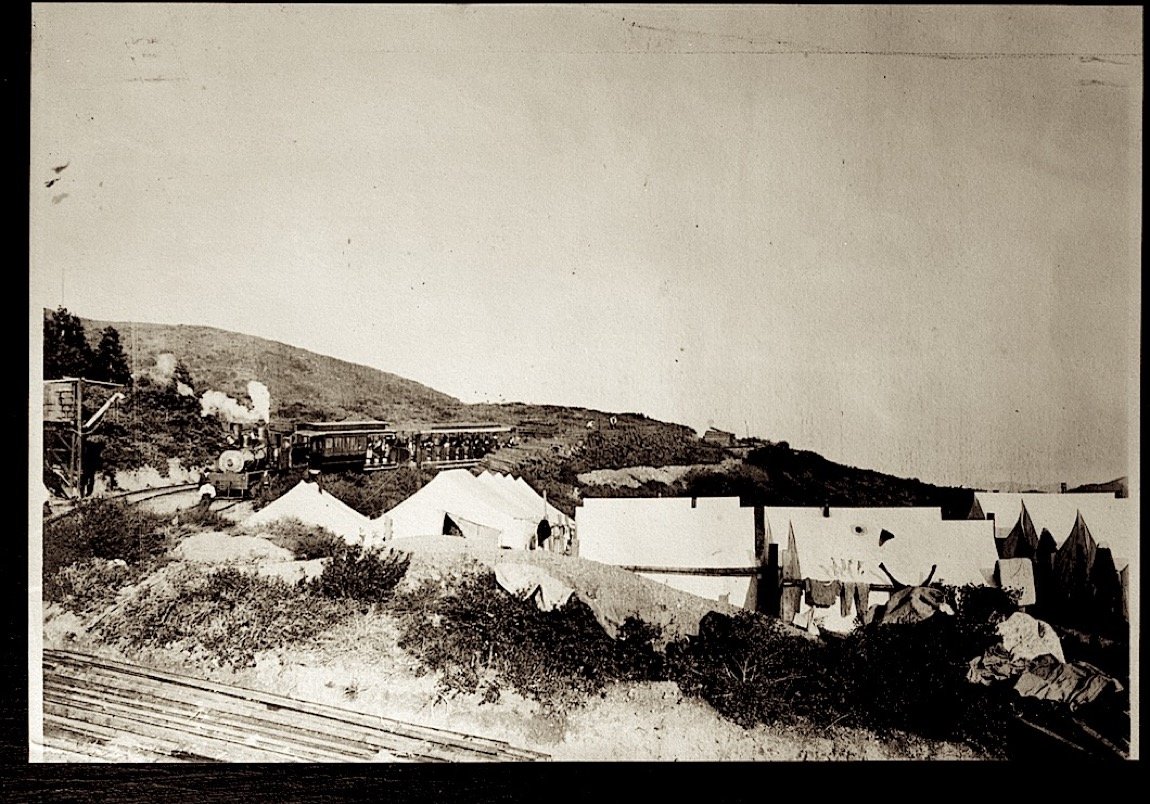
From 1907 a branch line left the main line here, heading southwest down to Muir Woods - then known as Redwood Canyon.
The branch was built from late 1906 to spring 1907 and carried the first tourists to Muir Woods by rail. In January 1908 President Theodore Roosevelt proclaimed Muir Woods a national monument, and the railway opened the Muir Woods Inn near the end of its branch.
Construction tents at Mesa Station, 1906 - building the Muir Woods branch · Mill Valley Public LibraryEngine No. 7 at the first Muir Woods Inn, c. 1908–13 · Mill Valley Public Library
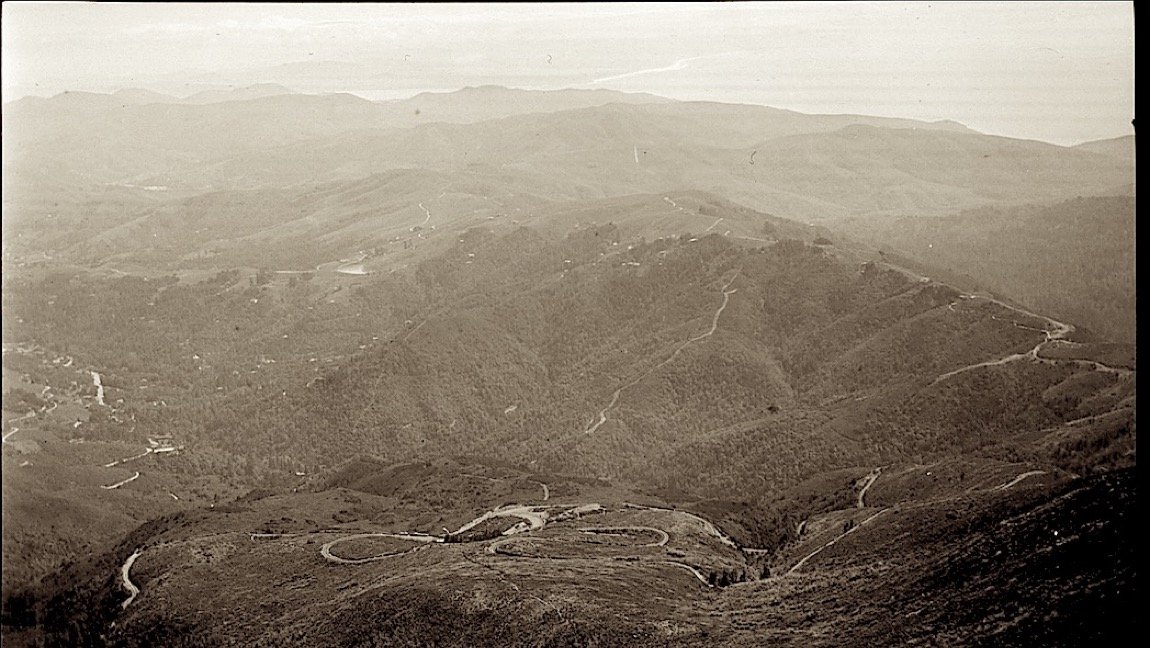
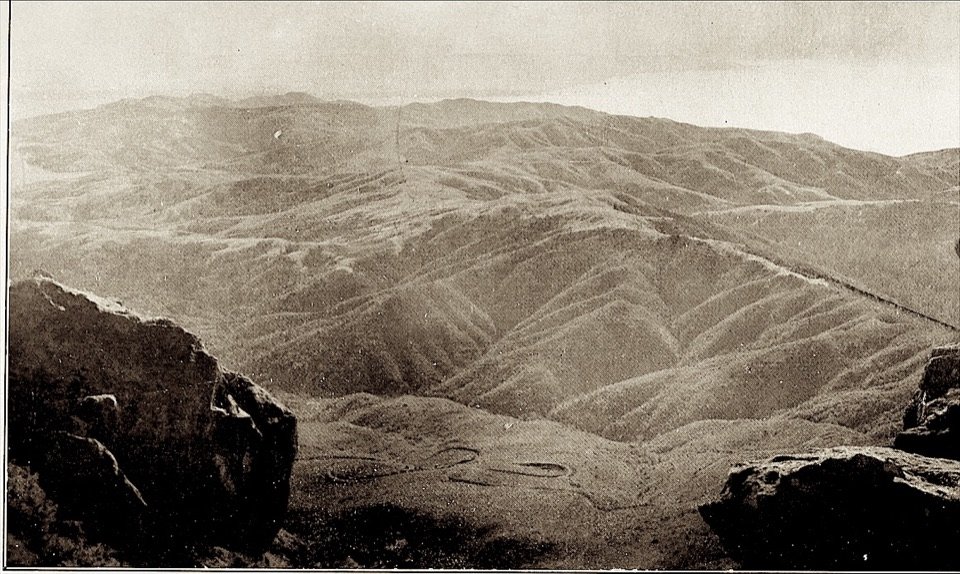
Here the track doubled back on itself again and again, climbing 168 feet within a space about 600 feet wide - and, at the halfway point of the whole line, ran its longest straight: just 413 feet. Mesa Station was a water stop, and the junction for the branch. Among the first tourists the railway carried to Muir Woods was the naturalist John Muir.
“The Crookedest Railroad in the World” - the railway’s own brochureThe Double Bow Knot in Scientific American, July 16, 1898 · public domain
Bingham watched the line turn “innumerable sharp curves, finally twisting into a double bow-knot” before it went on winding up the mountain.
“The Bow-Knot”, its loops seen far below - In Tamal Land, 1906
West of the Bow Knot · 1,350 ft
A fatal wreck
Just west of the Double Bow Knot, 1,350 feet up, Heisler locomotive No. 2 left the rails on August 22, 1900, a quarter of a mile before Milepost Five. Grease on the rail sent the engine toppling down the slope; escaping steam fatally scalded the engineer, Ernest Thomas.
The engine was No. 2, a Heisler nicknamed “the Bull” - the same engine seen in Edison’s 1898 films. Ernest Thomas was one of only two employees ever killed on the line; in all its years the railway never lost a passenger.
Boot Jack · 1,730 ft
Boot Jack - and the turn at West Point
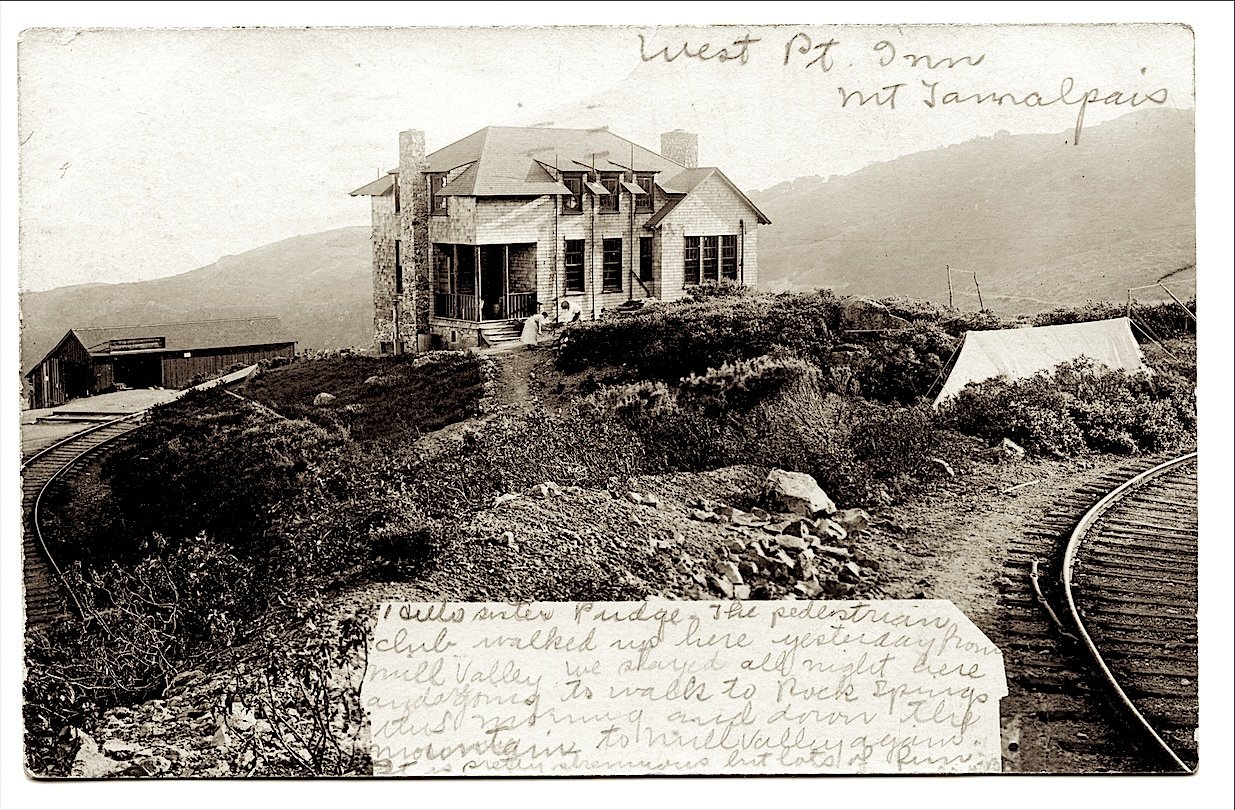
Boot Jack Siding stood at Milepost Six, 1,730 feet up. Half a mile further the tracks finished their westward climb at the West Point Inn, curving around it in a tight 252° turn and pointing back east.
A “West Pt. Inn” postcard - the tracks curving around the Inn
West Point Inn · 2,060 ft
Past the West Point Inn
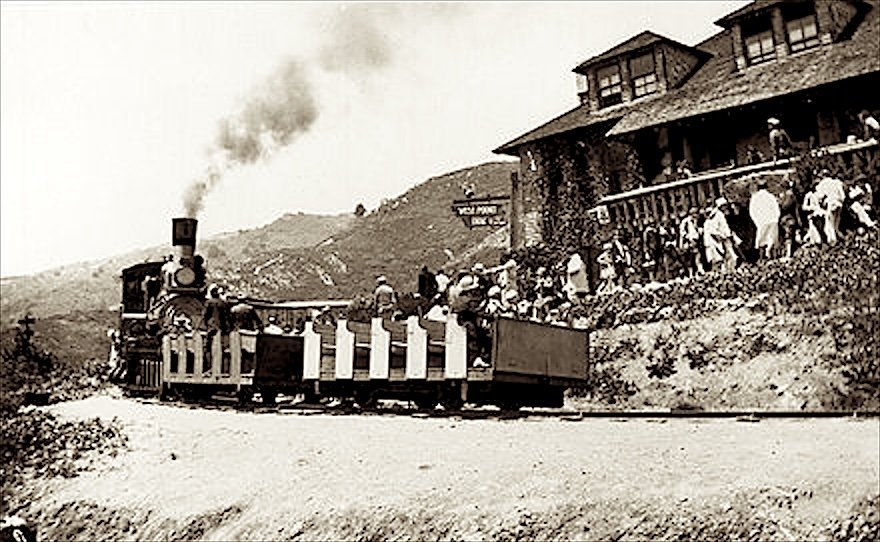
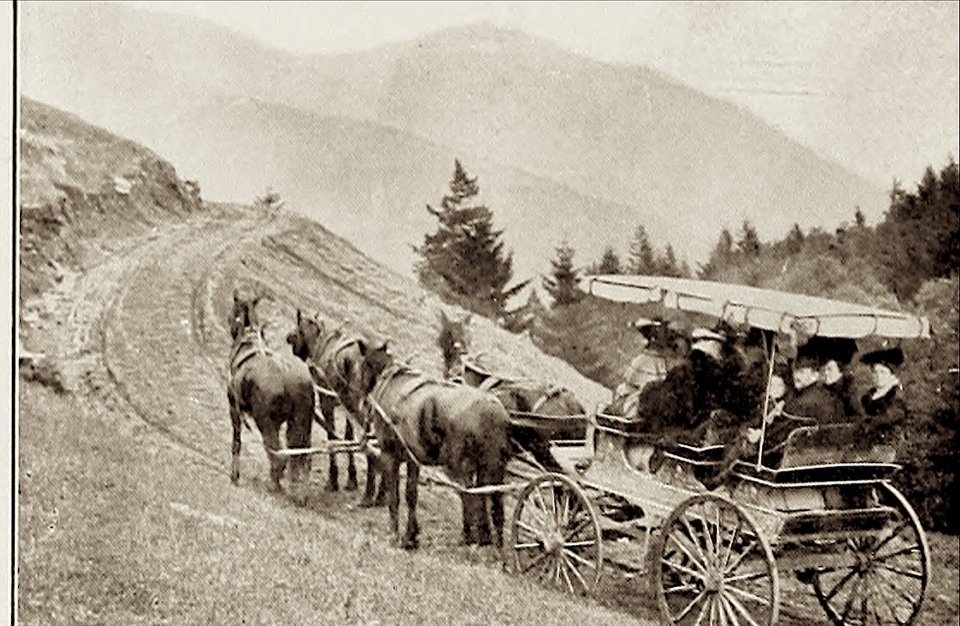
Milepost Seven, at 2,060 feet, lay half a mile past the Inn - where trains met the stages for Willow Camp and Bolinas, and where, in 1912, a young Erich Stroheim waited on tables.
The railway built the Inn in 1904 for about $2,500 (about $90,000 today), at the request of its president, Sidney B. Cushing; it opened that September.
In 1913 the railway began building on toward Bolinas, but got only as far as a siding at West Point - where it parked the extra trains for Mountain Play crowds, who walked the last 1.7 miles to the theater.
Helen Bingham, In Tamal Land, 1906
In 1906 Helen Bingham, in her book In Tamal Land, described the train “stopping a few moments at West Point, where passengers for Bolinas take the stage” - and on her way down she “alighted and after lunching at the Inn, mounted the stage which was bound for Bolinas,” catching the salt breeze from the ocean at every bend.
A train at the West Point Inn“The Bolinas Stage” - In Tamal Land, 1906
Near the top · 2,350 ft
Milepost Eight
Milepost Eight stood further east, 2,350 feet up. From here the tracks wound around a broad curve for just under a quarter of a mile to the end of the line.
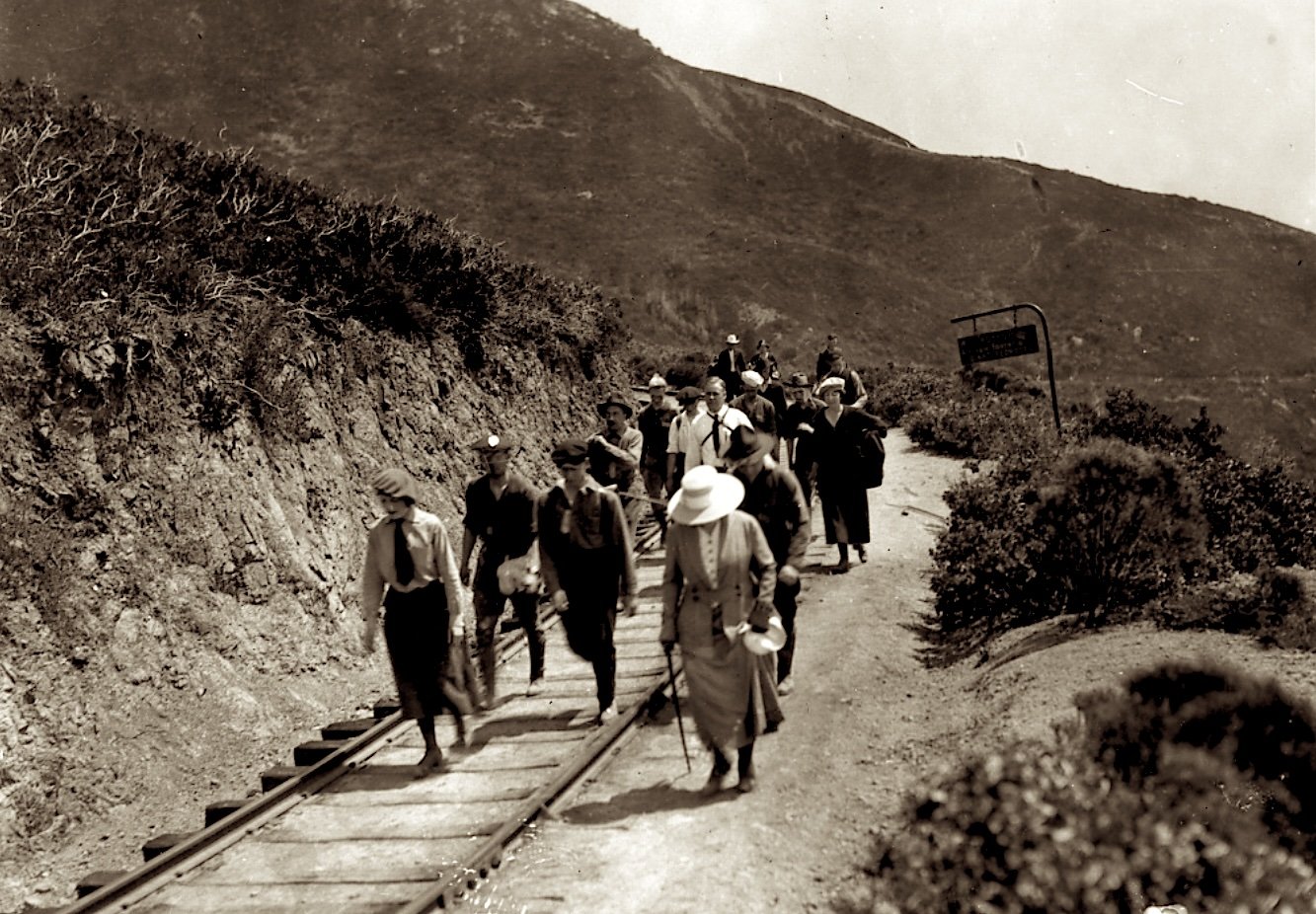
Walking the lineLooking down from the summit on the Double Bow Knot, with a train steaming up · Mill Valley Public Library
Near the top, Bingham wrote, the hills merged into one mass stretching west to the Pacific, where the Farallon Islands could often be seen, with the City and the bay to the south and east.
“From the Crest of Mt. Tamalpais” - In Tamal Land, 1906
East Peak · 2,436 ft
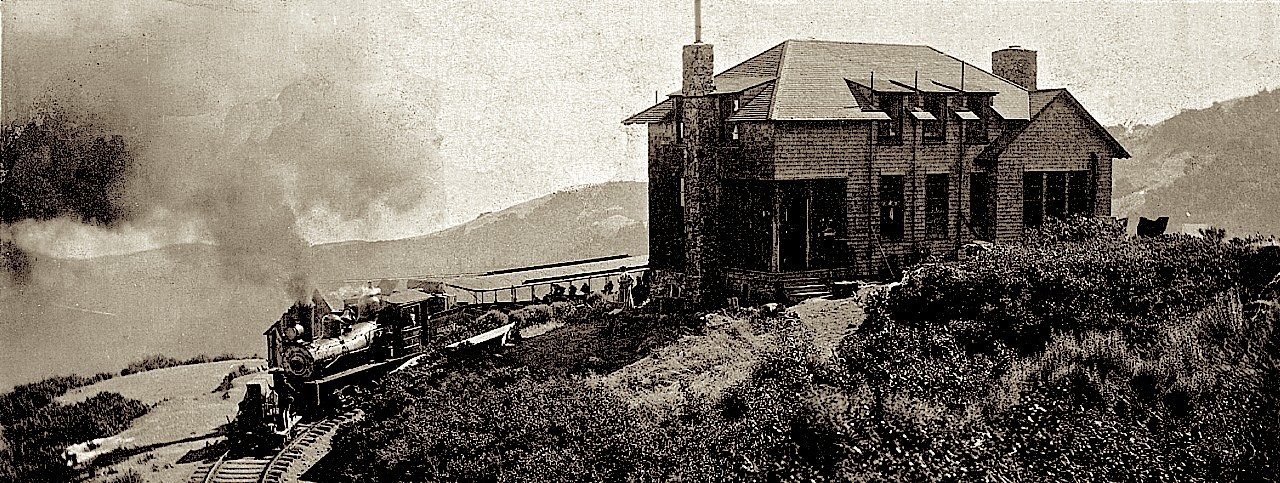
Tamalpais Tavern
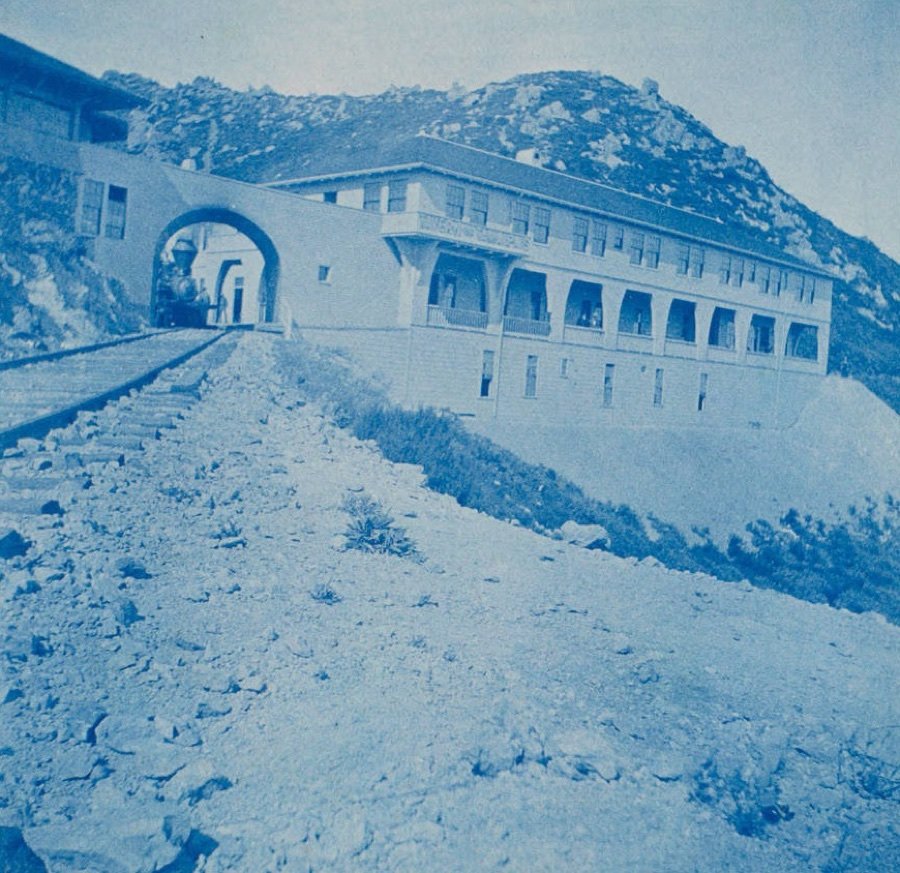
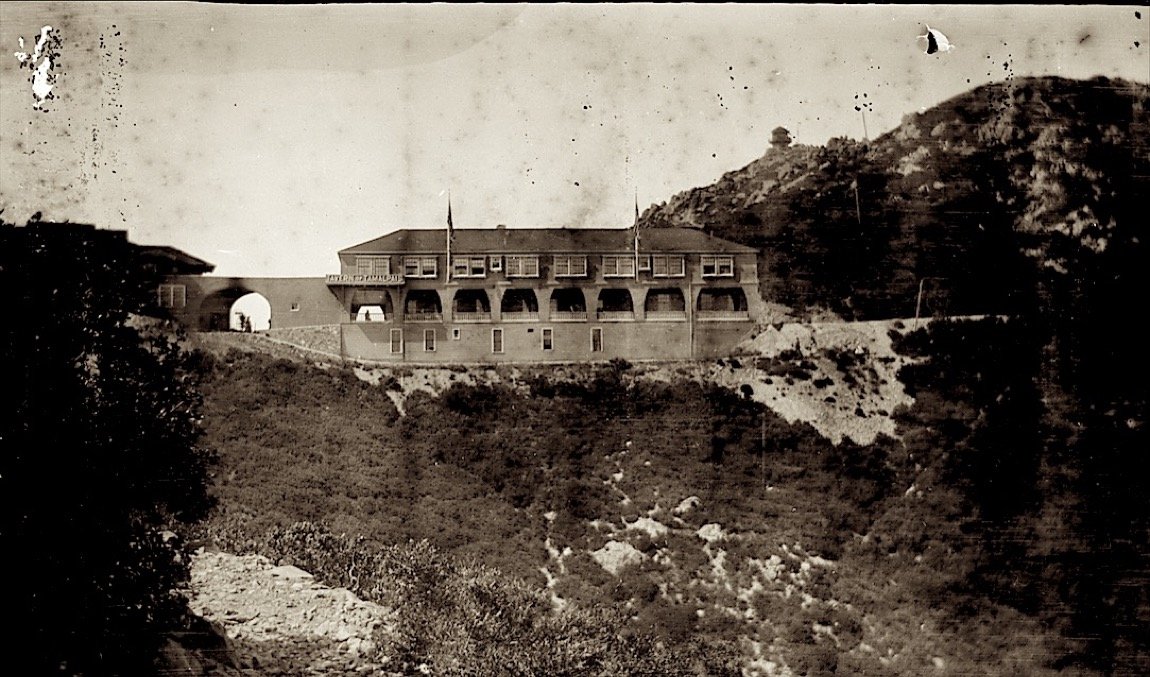
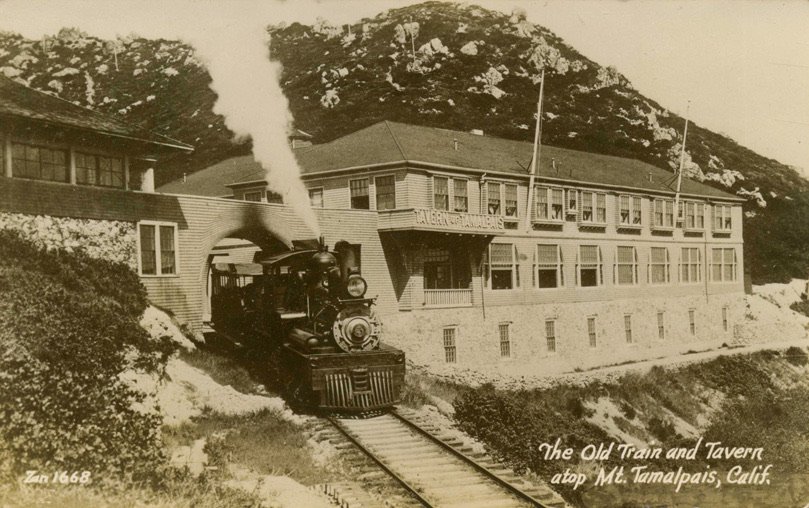
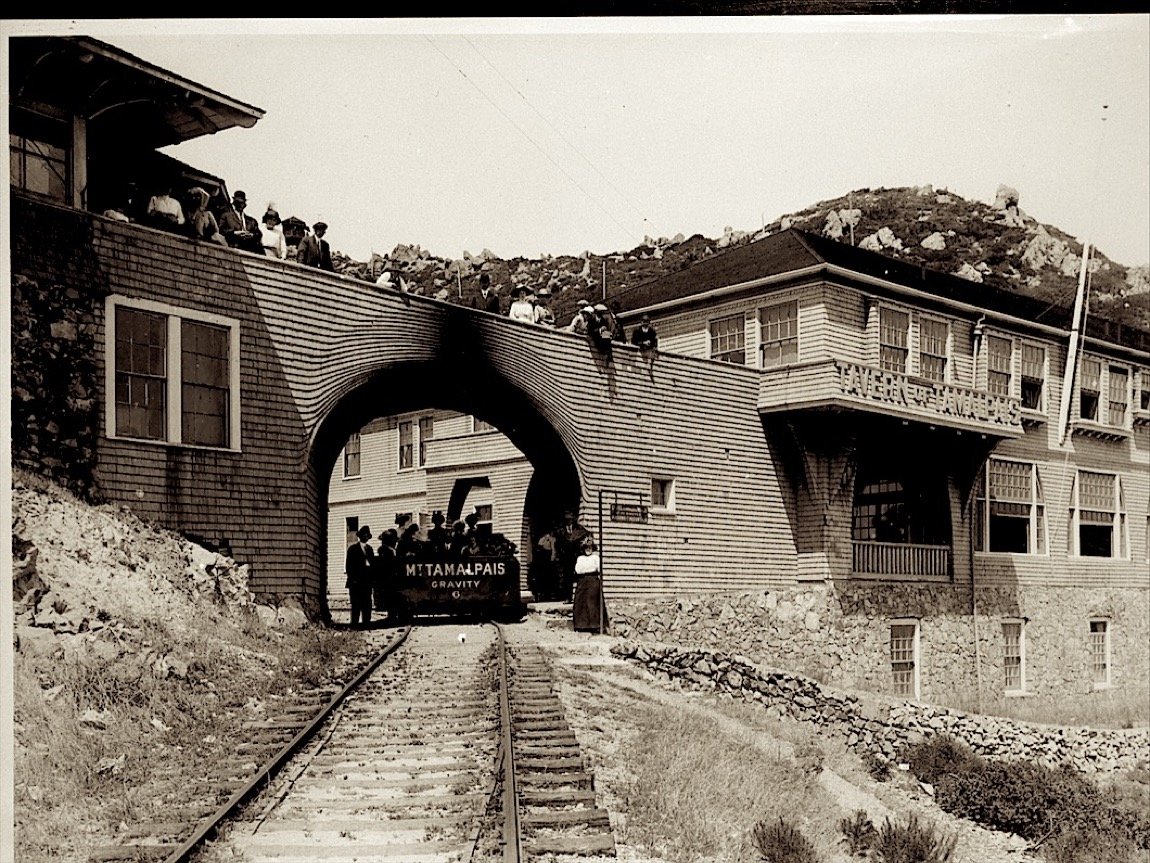
The Tavern near the summit opened in the fall of 1896, a few months after the trains began running, and became famous across the Bay Area for its fine dining room and comfortable rooms. It was enlarged in 1900; the building beside it began as a restaurant and later became the dance pavilion.
The Tavern burned to the ground in June 1923 and was rebuilt in November 1924 in a more modest style, with no rooms. It stayed open until the Second World War - outlasting the railway, which ended service in 1929.
Weeks after the line opened, on September 16, 1896, suffrage leader Susan B. Anthony - then 76 - rode to the summit as a guest of the railroad and spoke to two women’s groups there, on a campaign tour for an amendment to the California constitution giving women the vote. Early in 1898 an Edison film crew shot three short films on the mountain trains, including one leaving the Tavern - watch them below.
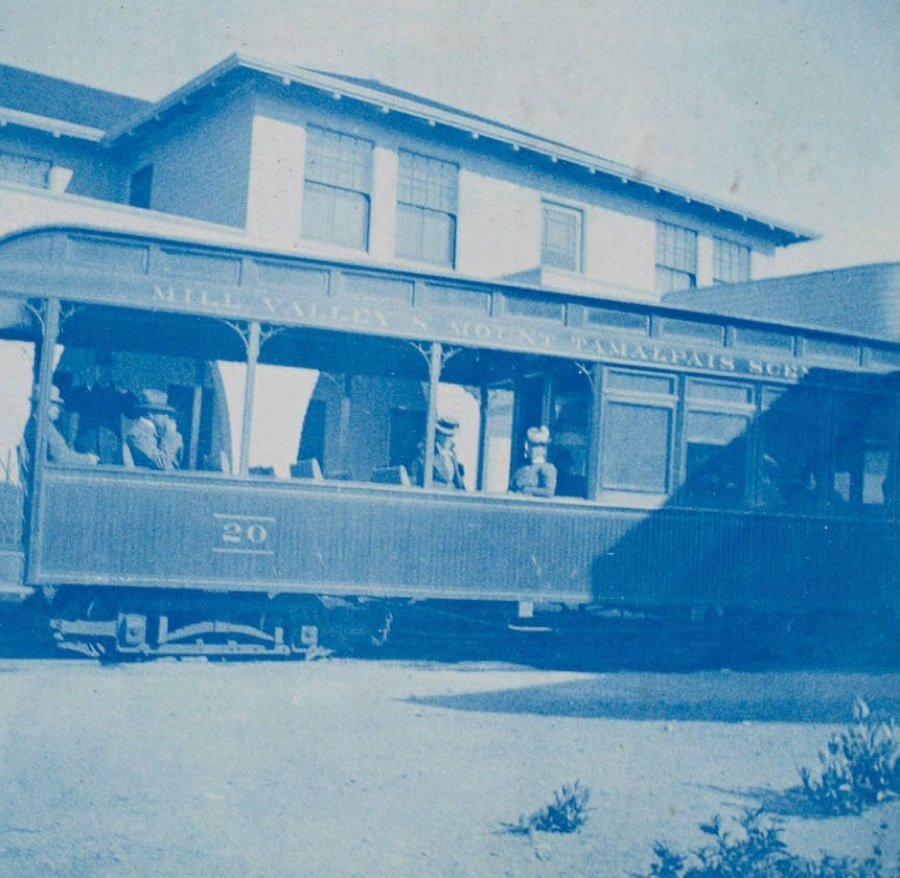
“Tavern of Tamalpais” - Jack London’s own cyanotype print, c. 1900–1910 · The Huntington LibraryCar No. 20 of the Mill Valley & Mount Tamalpais Scenic Railway at the Tavern - also by Jack London · The Huntington Library
The Tavern was enlarged by more than 30 rooms in 1900. When it was rebuilt after the 1923 fire it served railway passengers and, from 1925, motorists too.
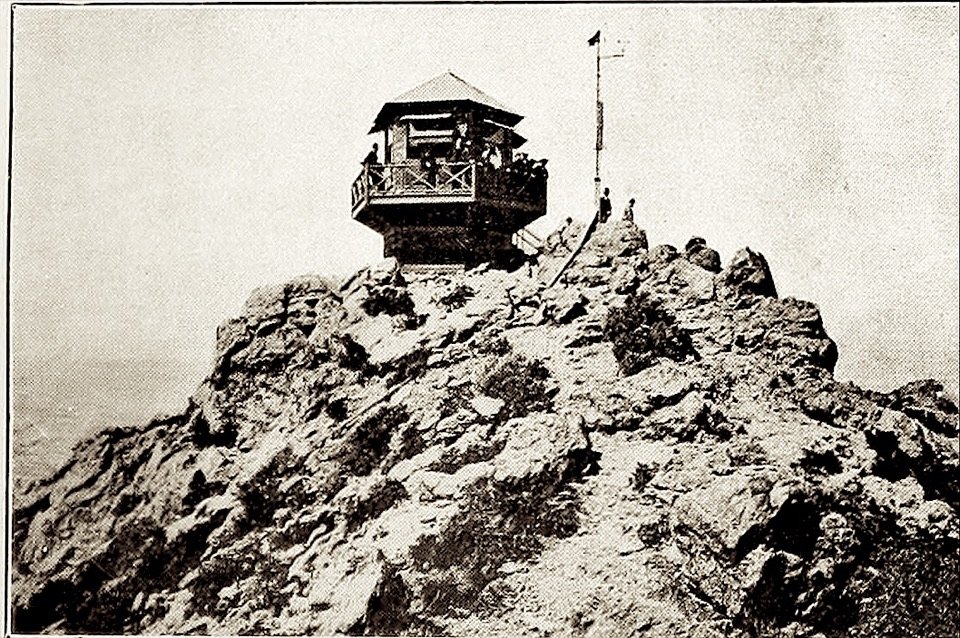
Bingham’s passengers “alight to luncheon in its well-appointed dining-room, or lounge on the spacious veranda.” Zigzag steps climbed from the Tavern to the top, where the San Francisco Examiner’s Marine Observatory had a telescope “said to sight ships seventy miles at sea” - and a Weather Bureau station stood a few hundred feet away.
The first Tavern of Tamalpais, an early view, c. 1896–1900 · Mill Valley Public Library“The Old Train and Tavern atop Mt. Tamalpais” - postcard, c. 1920 · public domain, via Wikipedia“The Marine Observatory” on the summit - In Tamal Land, 1906
The ride down
Gravity cars
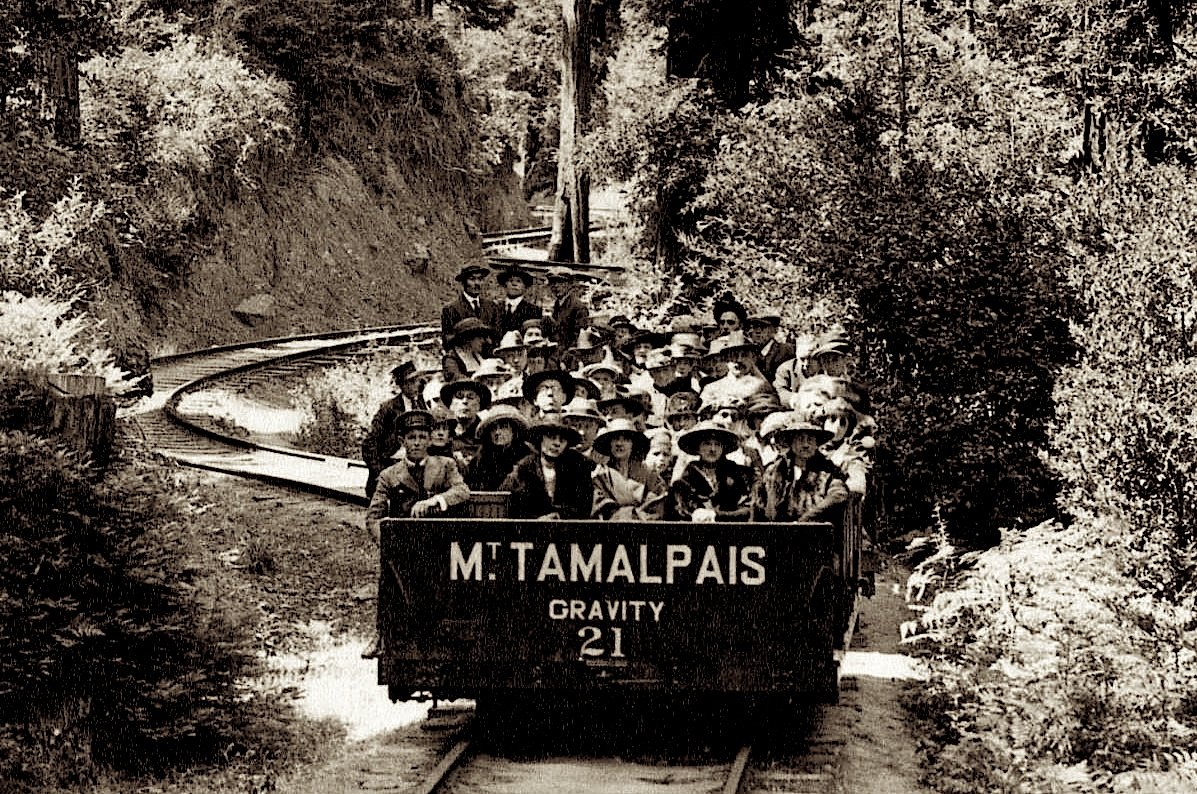
The railway was famous for its gravity cars - open four-wheel coasters, first introduced in 1902, that rolled all the way down the steep, relentless grade. A “gravityman” sat in the front right seat working two brake levers, under strict orders to keep to 12 miles an hour as the cars glided down to Muir Woods or into Mill Valley.
“Gravities” ran to a timetable like every train on the single-track line, and the steam engines towed them back up to the summit for the next run.
By 1913 the railway had 16 gravity cars. Coasting down from the Tavern took 8 minutes to West Point, 12 to the Double Bow Knot and 14 to Lee Street. Passengers never rode them on the tow back up - but a railway man rode each car to work the brakes.
Gravity car no. 21, c. 1915 · Mill Valley Public Library, Lucretia Little History Room (CC BY 3.0)Gravity Car No. 6 about to leave the first Tavern, under its bridge · Mill Valley Public LibraryBoarding a gravity car at Mesa Station, on the Double Bow Knot · Mill Valley Public Library
On film, 1898 & 1917
The railway in moving pictures
Early in 1898, two years after the line opened, Thomas Edison’s company sent a film crew west along the Southern Pacific. On Mt. Tamalpais cameraman Frederick Blechynden, working for producer James H. White, shot three short silent films from the trains. The paper prints sent for copyright in March 1898 survive at the Library of Congress, and the films are in the public domain. A fourth film, from 1917, rides the gravity cars.
Mount Tamalpais R. R. No. 1 Nearing the summit from the back of a car, then “the Bull” getting up steam by the Tavern and following the train down past its porch.Mount Tamalpais R. R. No. 2 A lady rides the front of a flat car, her feathers and ribbons blowing, above a panorama of hills and valley.Mount Tamalpais R. R. No. 3 Climbing the scenic railway with another train just ahead - the steep grades and sharp curves plainly shown.Mount Tamalpais Gravity Railroad, 1917 Filmed from the cars as the railway carries tourists up the mountain - riders waving to the camera, the summit and its observation tower, and the views from the top.
The men behind it
Sidney Cushing & William Kent
1879Sidney B. Cushing - After his father, Dr. John Cushing, died, Sidney and his mother turned the Blithedale sanitarium into Mill Valley’s first hotel.
1896As president, Cushing drove the building of the railway, and hosted its first excursion lunch under the Blithedale redwoods on August 26.
1904The West Point Inn is built at Cushing’s request.
1905William Kent - Kent and his wife Elizabeth buy Redwood Canyon to save its redwoods.
1908When a water company tries to take part of it for a reservoir, Kent gives the canyon to the nation; President Theodore Roosevelt proclaims Muir Woods National Monument, named for John Muir at Kent’s request.
1909Sidney Cushing dies. Kent remembered him as the man who first taught him the mountain was “too good a thing to be” privately owned.
1911–17Kent serves in Congress, where he helps create the National Park Service in 1916.
1915The Kents give the land for the Mountain Theater, dedicated to Cushing as the Sidney B. Cushing Memorial Theater, and Kent hosts congressmen on the railway.
1923By now Kent owns the Tavern and is the railway’s chief stockholder. On June 30 a brush fire burns the 35-room Tavern.
1928Kent dies in Kentfield in March - the year Mount Tamalpais State Park is created.
All aboard
Famous passengers
1896Susan B. Anthony - The first known celebrity on the line. On September 16, 1896, weeks after it opened, the suffrage leader - then 76 - rode to the summit as the railroad’s guest and spoke to two women’s groups there, campaigning for California women’s right to vote.
1897Governor James H. Budd - On April 10, 1897 the Governor of California, with his staff and a party of politicians, rode up and spent the night at the Tavern.
c. 1900Jack London - The author rode to the summit at least twice around 1900–01, just after the Tavern was enlarged - and his own photographs of the Tavern and car No. 20 (above, at the Tavern) survive in his albums at The Huntington Library. He gave the mountain a walk-on part in his 1904 novel The Sea-Wolf, which opens with a summer cottage “in Mill Valley, under the shadow of Mount Tamalpais.”
1907John Muir - The naturalist was among the first tourists the railway carried down its new branch into Redwood Canyon - named Muir Woods in his honour the following year.
1912Erich Stroheim - Not a famous passenger yet: a young Austrian waiting on tables at the West Point Inn, serving the railway’s guests. Seven years later, as Erich von Stroheim, he made Blind Husbands.
1915Congressman William Kent - On May 28, 1915 Kent - who had given Muir Woods to the nation - took fellow congressmen and their families up the mountain by train and down by gravity car to a barbecue in Muir Woods. He credited railway president Sidney Cushing as “the man who first taught me this mountain is too good a thing to be” in private hands.
1915Franklin D. Roosevelt, Vice President Marshall and “Uncle Joe” Cannon - A congressional party of about 250 visited the Tavern in 1915, among them Assistant Secretary of the Navy Franklin D. Roosevelt, Vice President Thomas R. Marshall and former House Speaker Joseph Cannon.
1923Sir Arthur Conan Doyle - In June 1923 the creator of Sherlock Holmes rode to the summit with his family and coasted down to Muir Woods by gravity car. “In all our wanderings,” he wrote, “we have never had a more glorious experience.” The railway, he added, was “a most reverent steward of its lands, making it accessible and yet tenderly guarding it from all vulgarity.”
The end of the line
The line through time
1912A gasoline motorcar built in the railway’s own Mill Valley shops joins the line - good for 25 mph on the climb back from Muir Woods.
1913Reorganized and renamed the Mt. Tamalpais & Muir Woods Railway, with 6 locomotives, 19 open cars and 16 gravity cars. A five-day fire chars the mountain from West Point to East Peak; more than 7,000 firefighters fight it, and the railway helps.
1915The busiest year, during San Francisco’s Panama-Pacific Exposition - by some counts around 700 passengers a day in summer, and nearly 1,000 a day to Muir Woods.
1917–18The First World War and the 1918 flu epidemic slow the railway down.
1920Engine No. 9, a Heisler, is the last locomotive the railway buys. Sold in 1924, it is the only piece of the railway’s equipment to survive - and it is being restored today.
1925Ridgecrest Boulevard brings automobiles to the upper mountain, and cars begin drawing riders away from the trains.
July 2, 1929The Great Fire roars down Blithedale Canyon to within two blocks of the Mill Valley depot. The last train down carries 65 passengers through the smoke, on rails made slippery by snakes fleeing the flames. The West Point Inn survives; the railway repairs the line and runs again.
Oct 31, 1929The last train runs.
1930The tracks are pulled up and sold, and most of the engines go to logging companies - two as far as the Philippines. The roadbed becomes today’s Old Railroad Grade, walked and ridden by thousands every year, past the West Point Inn.
May 3, 2009The Gravity Car Barn museum opens in the old East Peak yard, with a recreated gravity car on 84 feet of track.
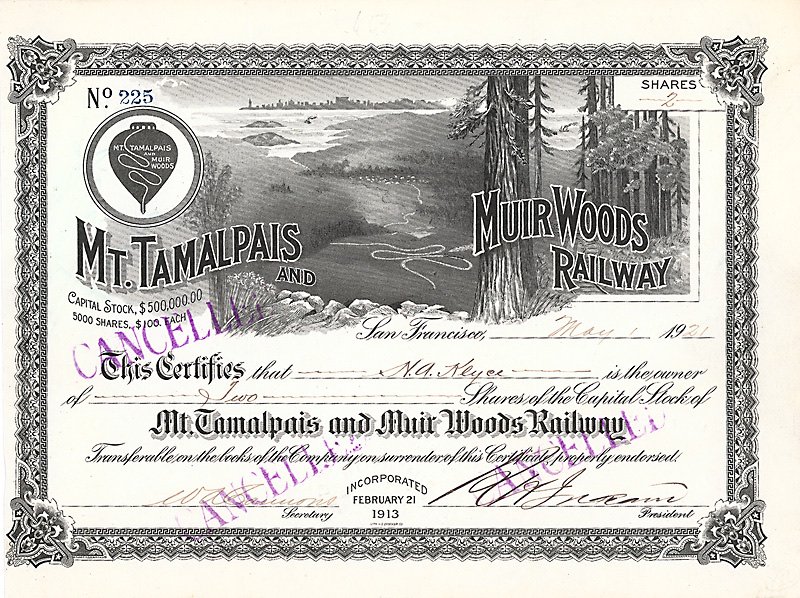
A share in the Mt. Tamalpais & Muir Woods Railway, May 1, 1921 - capital stock $500,000 (about $9 million today) in 5,000 shares of $100 (about $1,800 each), incorporated February 21, 1913 · public domain, via Wikimedia Commons