22 September 1885
Born in Vienna
Erich Oswald Stroheim is born at home in Vienna’s Seventh District, the son of Jewish parents - Benno Stroheim, a merchant with a hat shop, and Johanna Bondy, from Prague.
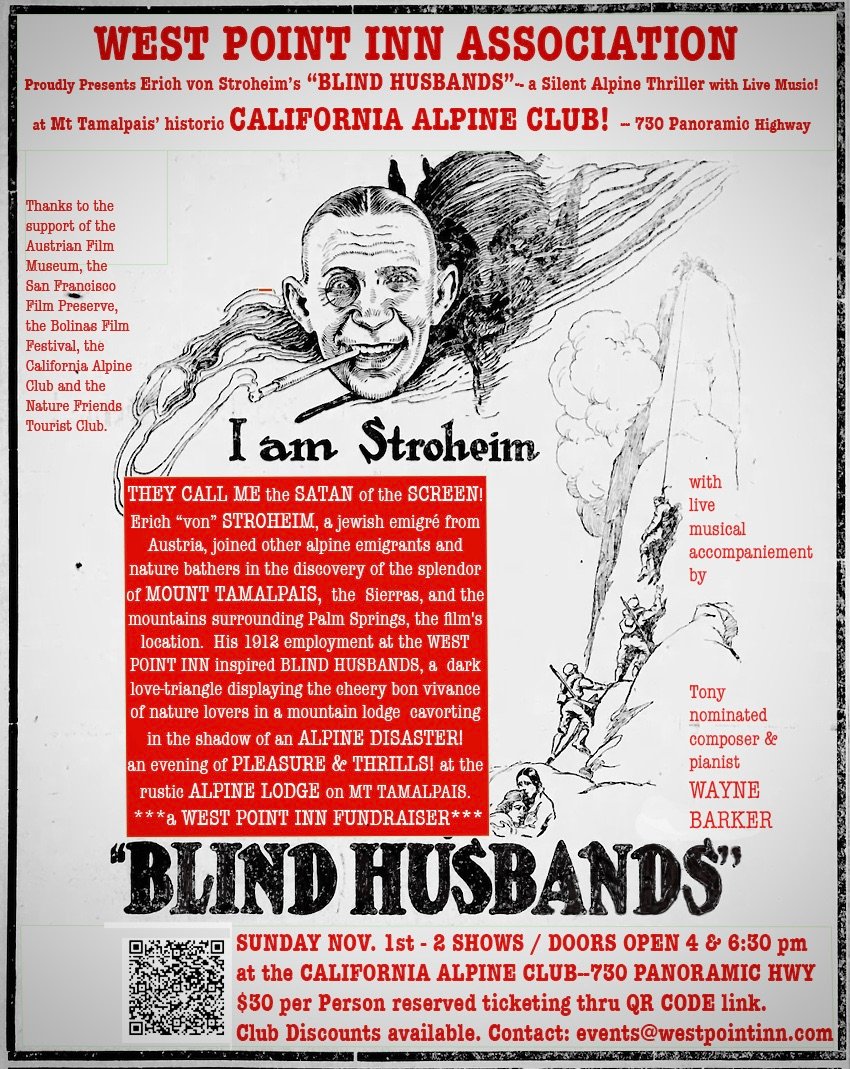
In 1912 a young Austrian waited tables at the West Point Inn. Seven years later, as Erich von Stroheim - one of the great directors of film history - he made this silent alpine thriller. See it with live music at Mt Tamalpais’ historic California Alpine Club.
The West Point Inn has stood on Mt Tamalpais since 1904. In 1943 it was nearly torn down as a fire hazard - and it survived because volunteers stepped in. It has been cared for by its members and volunteers ever since: a nonprofit association, monthly work parties, and a lot of love for an old railway lodge with no road to its door.
Keeping a 120-year-old wooden inn open on a mountain takes money as well as hands. This evening is a fundraiser: the proceeds go to the West Point Inn Association to help care for the Inn, its porch and its cabins - so that hikers, families and the next generation can keep coming up the mountain to it.
We also simply think it’s a wonderful story. The young man who waited tables on our porch in 1912 went on to make film history - and his first film was inspired by a mountain inn. We’d love you to come and see it with us.
- The West Point Inn Association
In 1912 Erich Stroheim, a 26-year-old Austrian émigré, found his way up Mt Tamalpais to the West Point Inn - a modest chalet two miles below the summit. The innkeeper, Captain Henry Masyon, known for his military bearing and his Franz Joseph beard, was an “old Austrian acquaintance”, and put him straight to work: everything from maintenance to waiting on tables.
It was at the Inn, by his own account, that he spilled a bowl of soup on Margaret Knox - who became his first wife, and encouraged him to read and to write. That writing led him to Hollywood.
His first film as a director grew from a script he called The Pinnacle, possibly drawn from his days at the Inn. Universal released it in 1919 as Blind Husbands: a love triangle among vacationers at a mountain resort, with Stroheim himself as the seducer - and a struggle for life on a mountain peak.
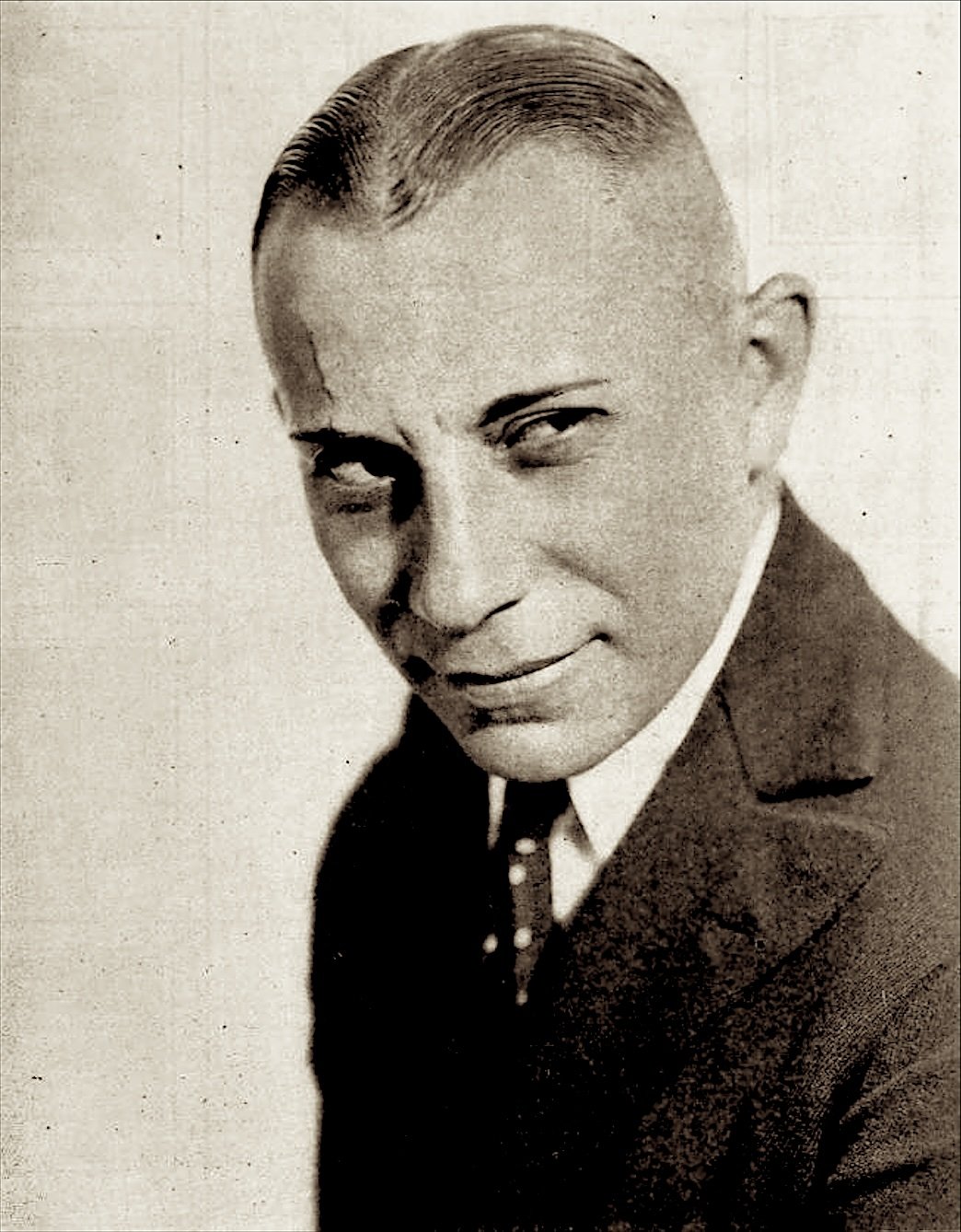
One of the most critically respected directors of the 20th century, celebrated for his uncompromising realism and accuracy of detail.
“It cost $42,000 - a lot of money then - and people were lining up for blocks to see it.”Francelia Billington, the film’s leading lady
Blind Husbands was planned at about $42,000 (about $790,000 today) and went far over budget. It took about $1 million (about $19 million today) at the box office - Universal’s biggest success up to that time - and made Stroheim’s name as a director.
In March 1957, too ill to leave his bed, Stroheim received France’s highest honour, the Légion d’honneur - the nation’s recognition of his contribution to art, in the country that revered him.
He would be on the A-list of auteurs - the rare director a studio hands a fortune and a free hand, then fights over the final cut. Think of him alongside:
Billy Wilder: “You were ten years ahead of your time.”
Stroheim: “Twenty.”
“We were all influenced by Greed.”
The very first sequence of Blind Husbands “announces the arrival of a new master of psychological realism.”
Blind Husbands “has less to do with Cortina d’Ampezzo than it does with the rugged landscape of northern California.”
Jean Renoir saw Stroheim’s Foolish Wives about ten times, and said it was Stroheim’s films that showed him a film could create a whole world of its own. He went into filmmaking - and later cast Stroheim in his masterpiece La Grande Illusion (1937).
Welles often championed Stroheim as a “true artist” of immense talent - a kindred spirit in the “holy trinity” of writing, directing and acting, whose grand designs, like his own, were cut down by studio executives.
Stroheim was “the only true novelist in films.”
“Erich von Stroheim was the most outrageous of the iconoclasts, and he fell the hardest… The very qualities that made him a great artist undid him.”
“It’s an incredible film … one of the greatest endings of all time.”
Roger Ebert celebrated Stroheim’s impact on film history - his uncompromising character work and visual storytelling anchored classics long after his own directing career was cut short, from La Grande Illusion to Sunset Boulevard.
George Lucas’s Lucasfilm put Stroheim on screen in The Adventures of Young Indiana Jones: Hollywood Follies (1994) - the young Indy is sent to Hollywood to rein in Stroheim’s over-budget Foolish Wives - and later made a documentary about him, Erich von Stroheim: The Profligate Genius.
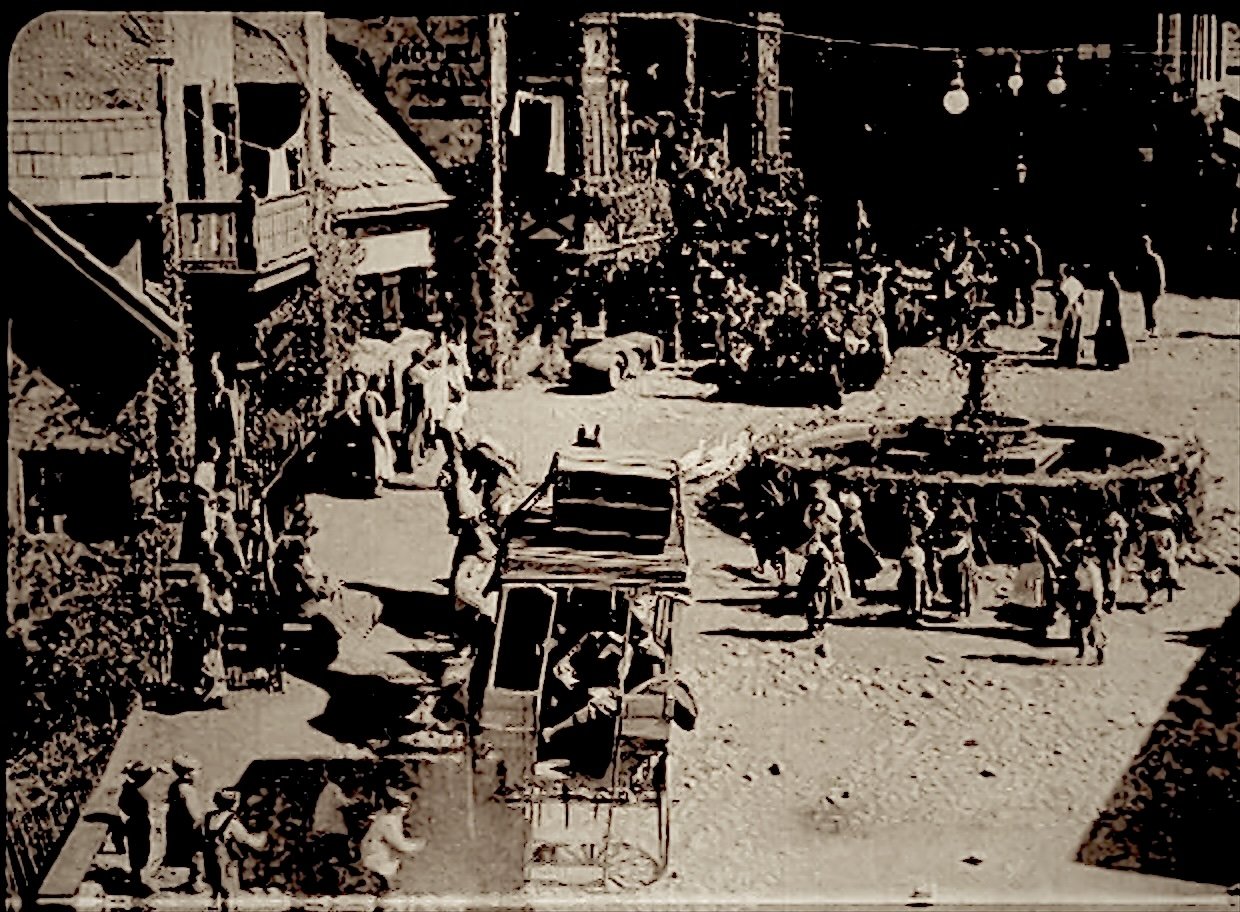
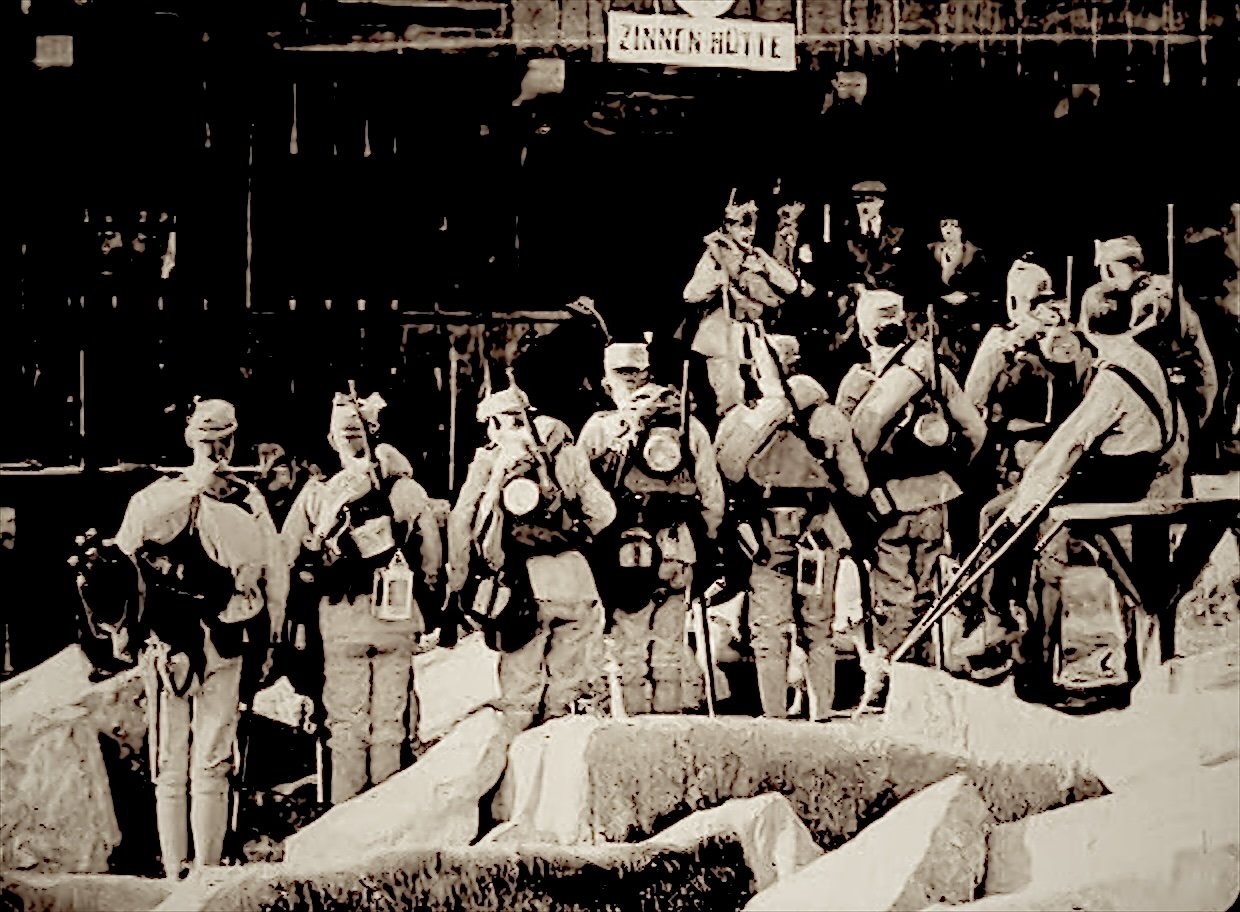
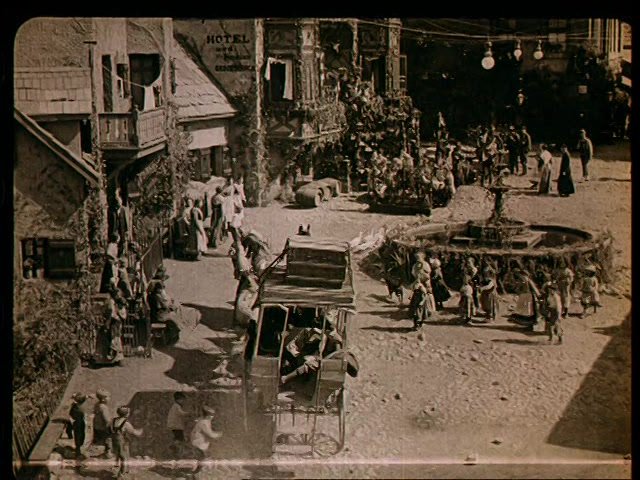
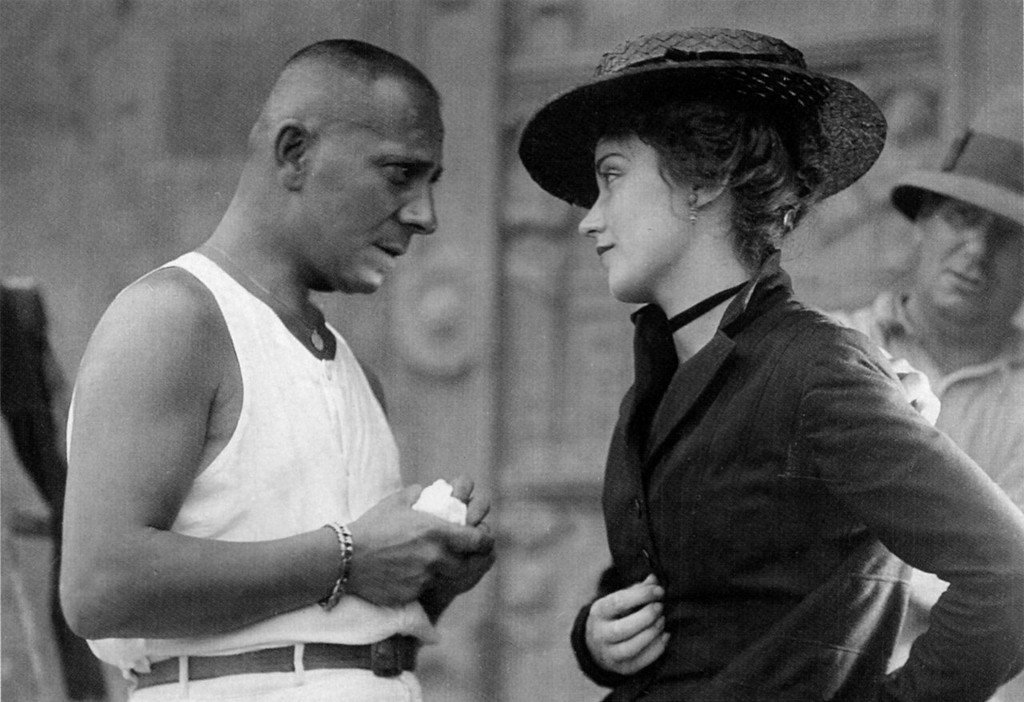
Scenes from Blind Husbands. On the night, the full film plays in the Austrian Film Museum’s remastered digital version - kindly donated - with live music by Wayne Barker.
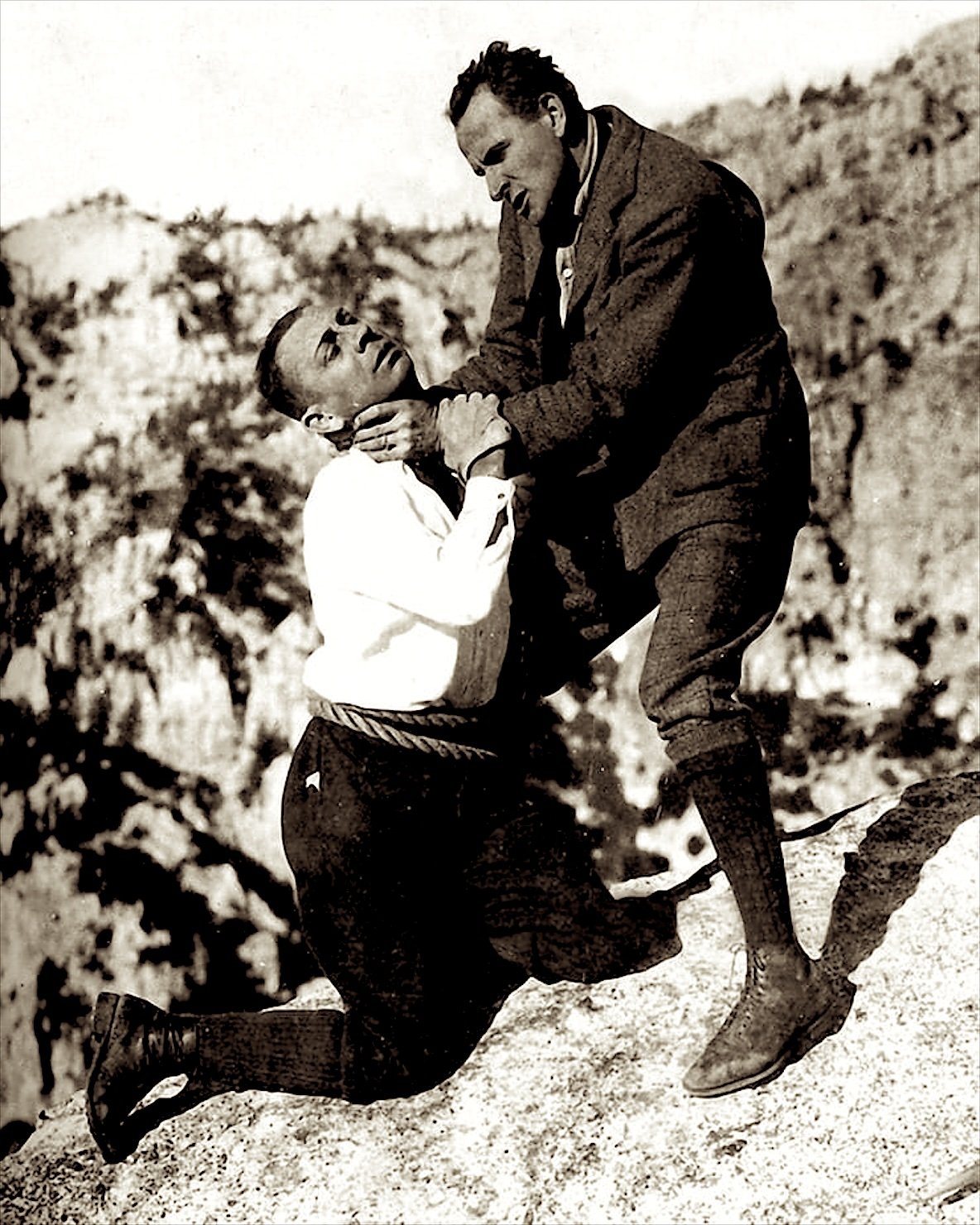
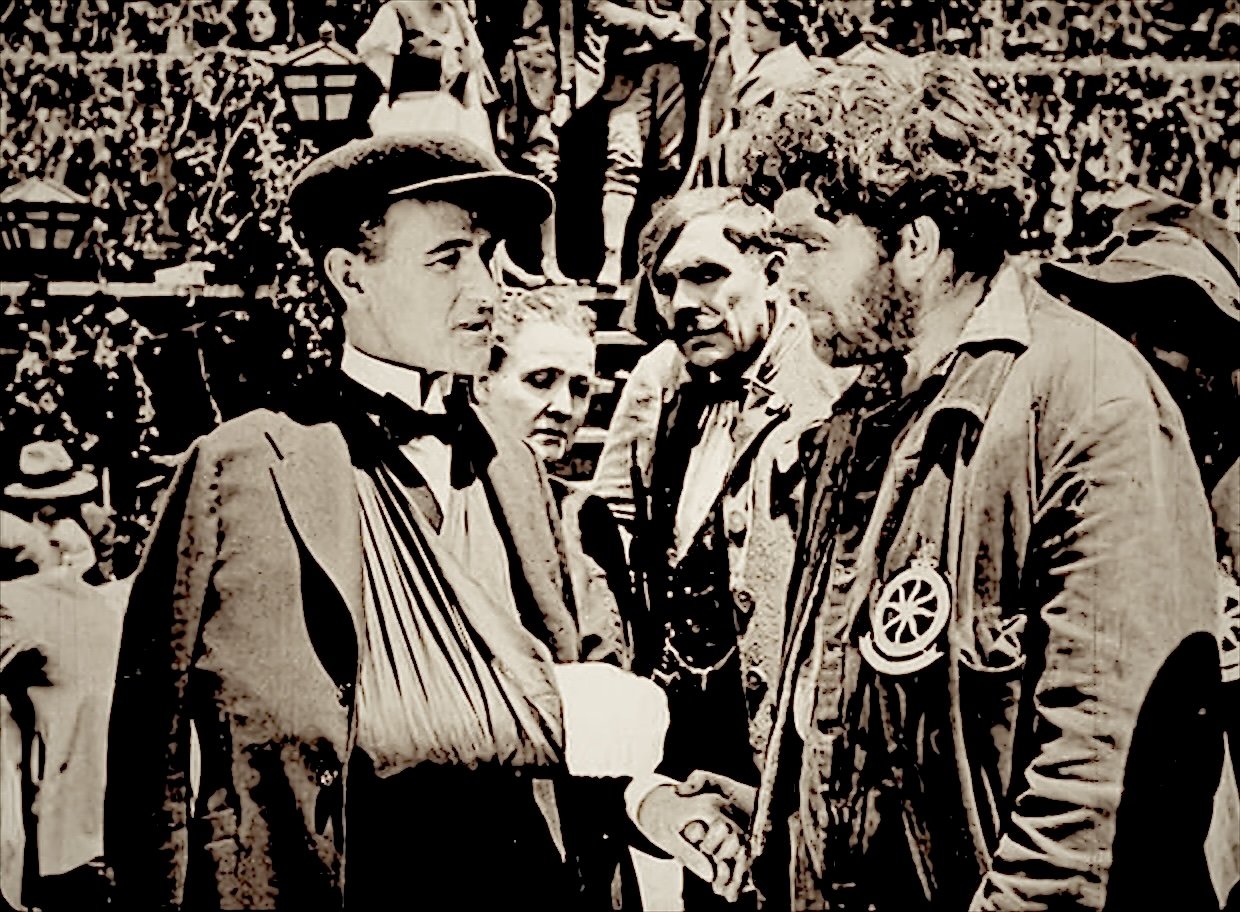
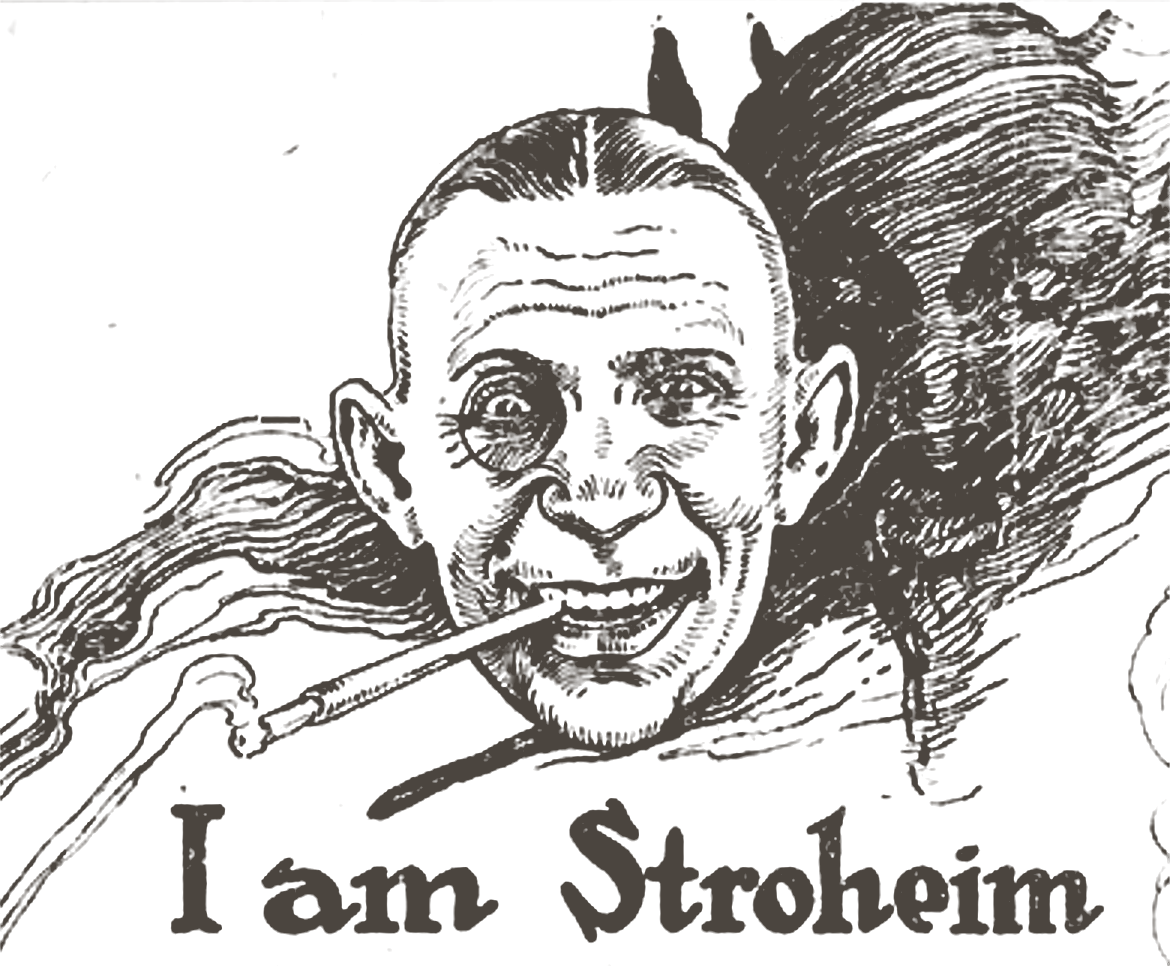
“They call me the Satan of the Screen!”
Erich “von” Stroheim, a Jewish émigré from Austria, joined other alpine emigrants and nature bathers in the discovery of the splendor of Mount Tamalpais, the Sierras, and the mountains surrounding Palm Springs, the film’s location.
His 1912 employment at the West Point Inn inspired Blind Husbands - a dark love triangle displaying the cheery bon vivance of nature lovers in a mountain lodge, cavorting in the shadow of an alpine disaster!
An evening of pleasure & thrills at the rustic alpine lodge on Mt Tamalpais.
*** A West Point Inn fundraiser ***
From Vienna to Mt Tamalpais to Hollywood - the dates that led to Blind Husbands.
From a Viennese hat shop to Ellis Island, Mt Tamalpais, Hollywood and Paris - Erich von Stroheim, 1885–1957.
Erich Oswald Stroheim is born at home in Vienna’s Seventh District, the son of Jewish parents - Benno Stroheim, a merchant with a hat shop, and Johanna Bondy, from Prague.
His dream of an officer’s commission in the Imperial Army ended in 1907, blocked largely by antisemitism in the officer class. Arriving at Ellis Island aboard the Prinz Friedrich Wilhelm, the merchant’s son gives his name as Erich Oswald Hans Carl Maria von Stroheim.
In the booming Bay Area he finds his way up Mt Tamalpais to the West Point Inn, two miles below the summit. Innkeeper Captain Henry Masyon - an “old Austrian acquaintance” with a Franz Joseph beard - puts him to work at everything from maintenance to waiting on tables.
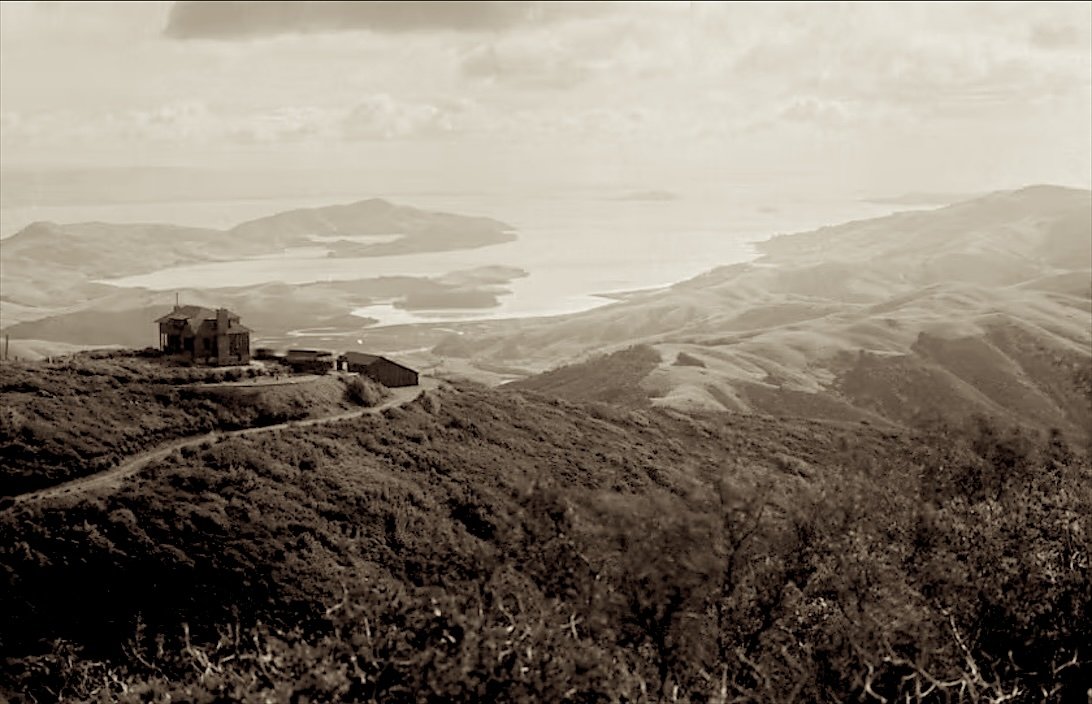
At the Inn he spills a bowl of soup on Margaret Knox - and soon moves into her Mill Valley cabin. They marry in February 1913. She teaches him literature and urges him to write: the first step on the road to Hollywood.
Working as a lifeguard and boat-tour guide, he meets wealthy tourists who back his one-act play. It closes in Oakland after one night - but brings him into contact with actors who work as movie extras.
He starts with menial work for D. W. Griffith’s company as The Birth of a Nation is released, and rises - thanks to his invented military past - to technical advisor and assistant director, including on Intolerance (1916).
A predatory lieutenant in Griffith’s Hearts of the World typecasts him as the screen’s cruel, monocled Hun - the villain audiences love to hate.
His first film as a director, from his own script The Pinnacle - possibly drawn from his days at the Inn. A love triangle at a mountain resort, with Stroheim as the seducer, it becomes Universal’s biggest success to date.
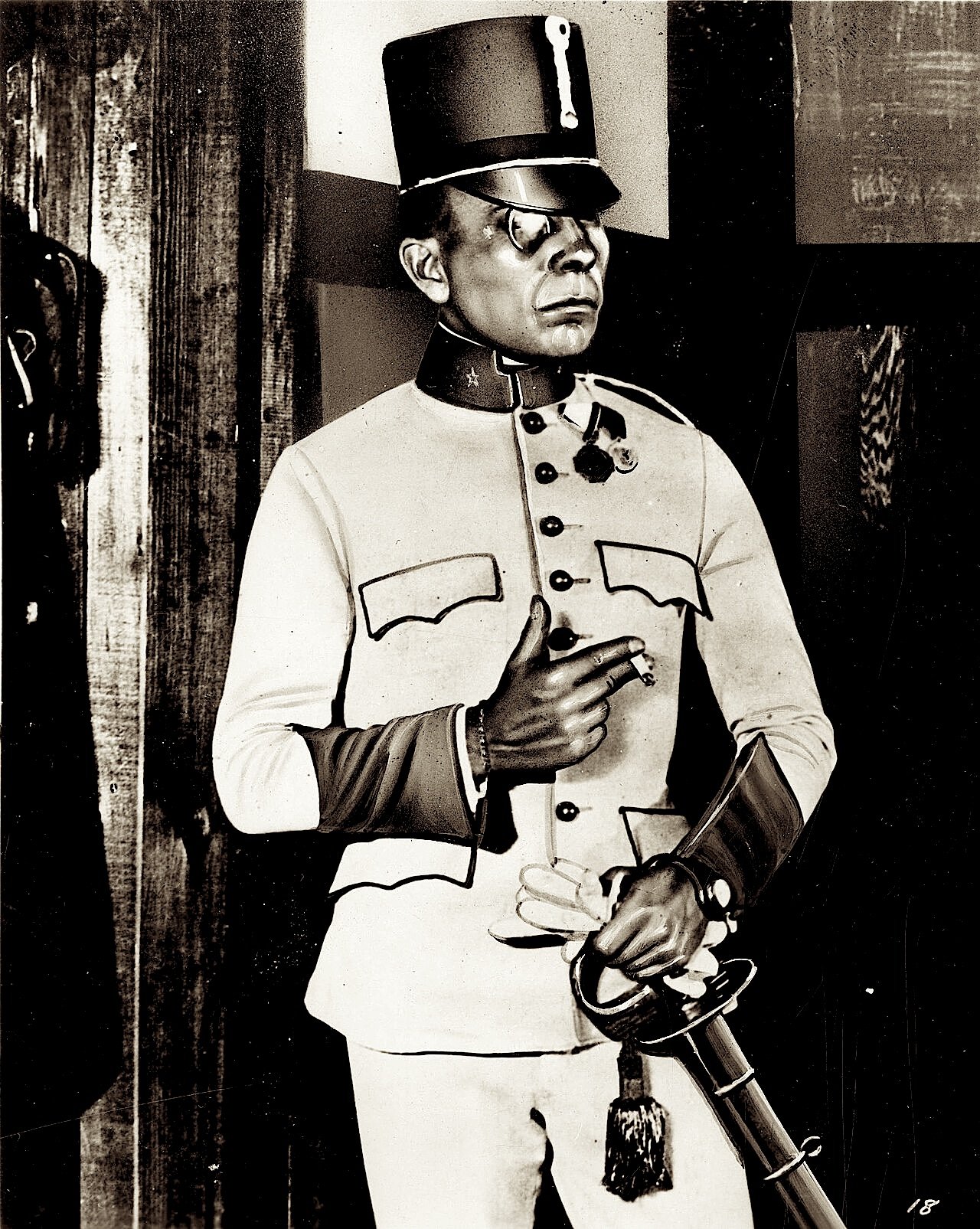
To film his tale of a fraudulent count preying on rich visitors to Monaco, Stroheim had the heart of Monte Carlo - its casino and the Café de Paris - built not once but twice: on the backlot at Universal City, and on the clifftops of Point Lobos near Monterey, where storms wrecked the sets and they had to be rebuilt. Universal billed it as “the first real million dollar picture.” It made him a brilliant auteur in the eyes of the world - and a financially reckless perfectionist in the eyes of the studio.
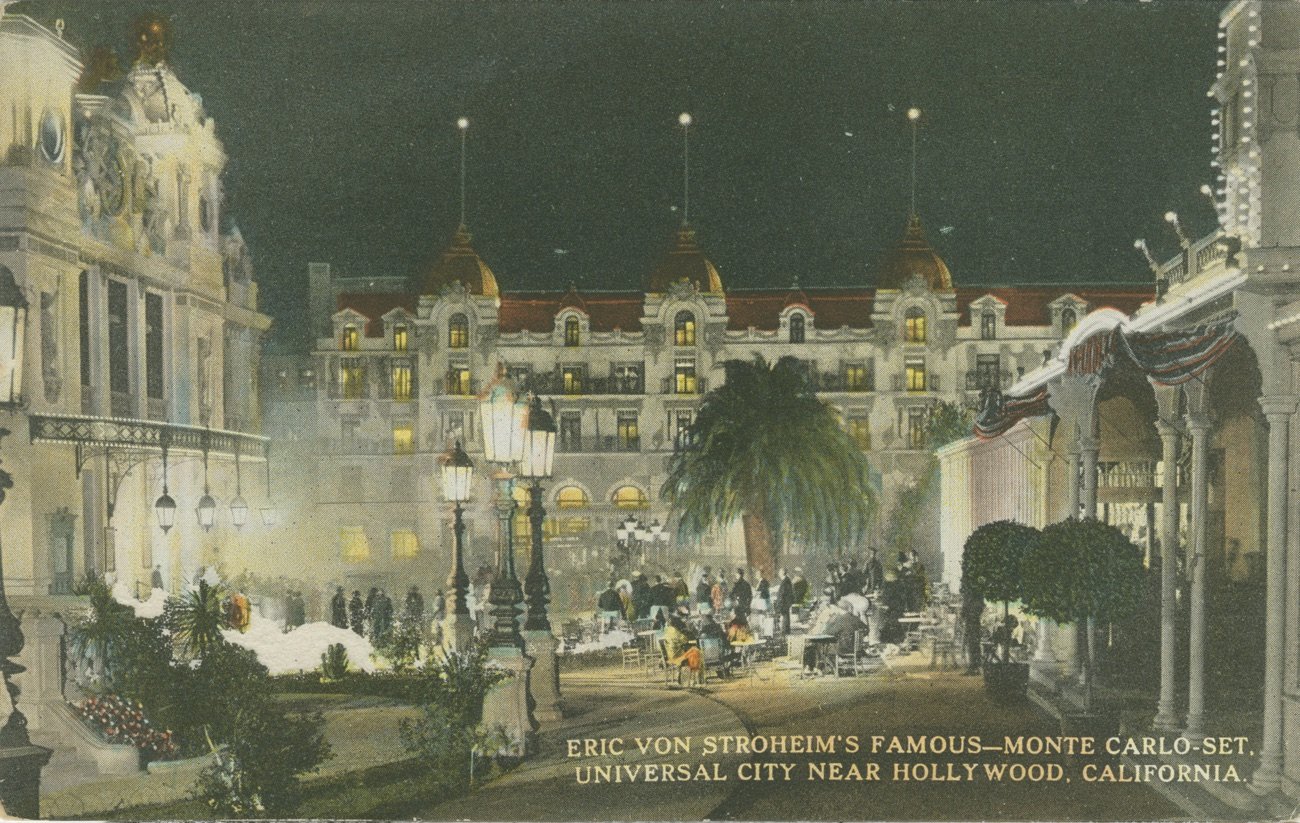
Eleven years after waiting tables at the West Point Inn, Stroheim returns to San Francisco to film Frank Norris’s McTeague on real locations - among them a Polk Street Improvement Club festival scene, with Jean Hersholt on a white horse and Stroheim in a white hat beside the camera - before moving on to Death Valley. The production stills survive at UC Berkeley’s Bancroft Library.
His masterpiece, and one of the greatest films ever made. While Hollywood sold glamour, Stroheim - like D. W. Griffith, one of the very few directors of the era to do so - turned his camera on the real state of ordinary life. From Frank Norris’s novel McTeague: a dentist and his wife in San Francisco’s working-class streets, ruined when Trina wins $5,000 in a lottery (about $95,000 today) and hoards it as gold.
He spent two years on it, filming on real locations - real San Francisco rooms and streets, and the punishing heat of Death Valley for the final, fatal chase - with pioneering deep focus and touches of colour. His first cut ran around ten hours. MGM’s Irving Thalberg ordered it cut down, and the missing footage was lost: one of cinema’s great lost treasures. A partial reconstruction uses surviving stills to fill the gaps.
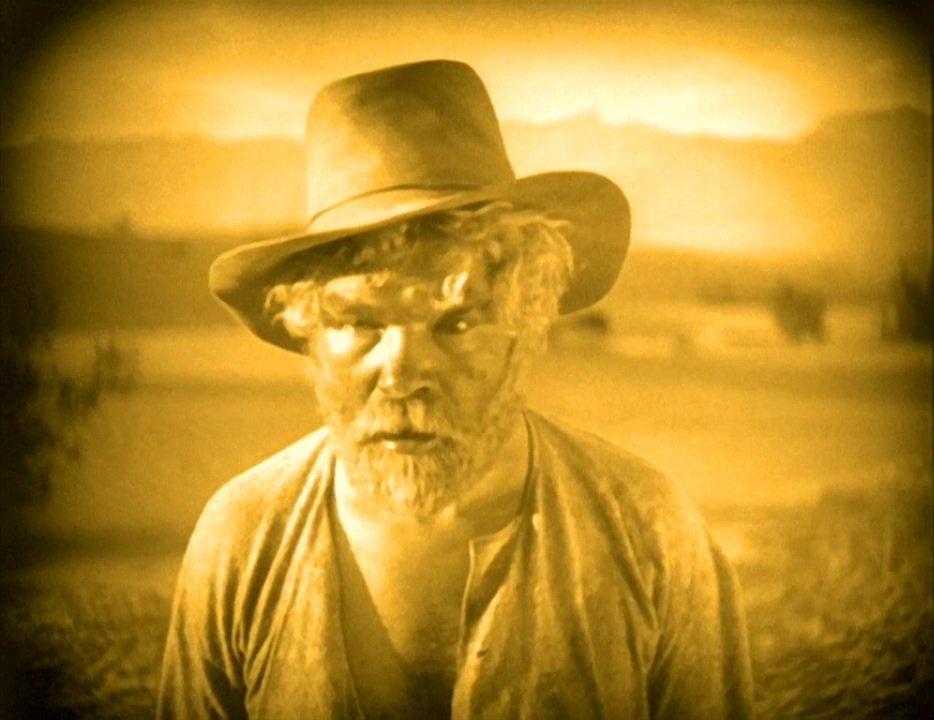
A deeply personal elegy for his native Vienna and its decaying aristocracy, with Fay Wray - and Stroheim as the impoverished Prince Nikki.
Financed by its star, Gloria Swanson, and left unfinished after clashes over money and art - the film that ended his career as a Hollywood director.
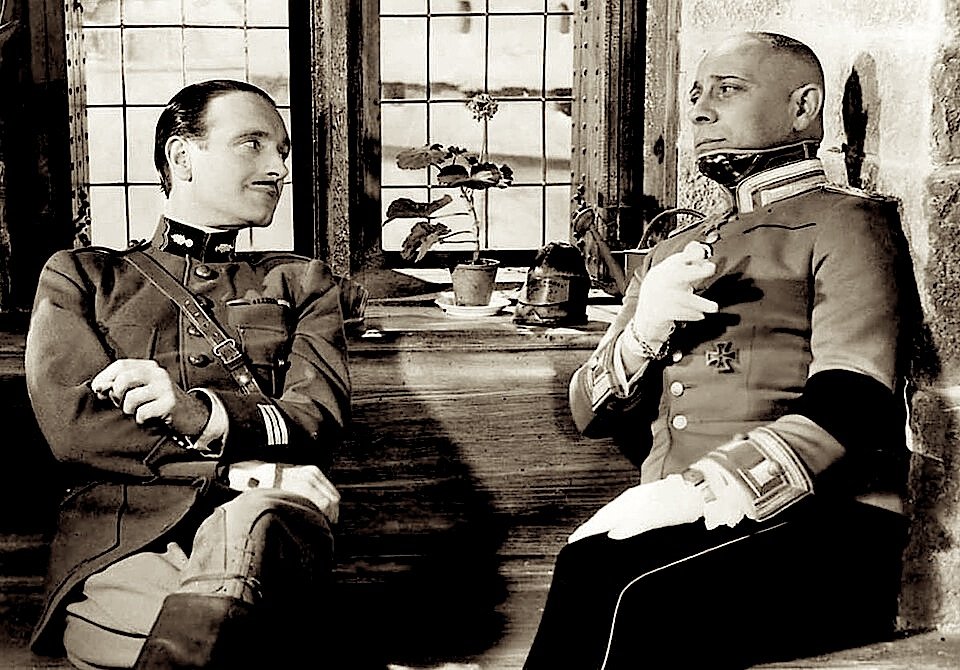
Barred from directing in Hollywood, he finds new acclaim in France - above all as the commandant in Jean Renoir’s masterpiece.
He appears on stage in Arsenic and Old Lace.
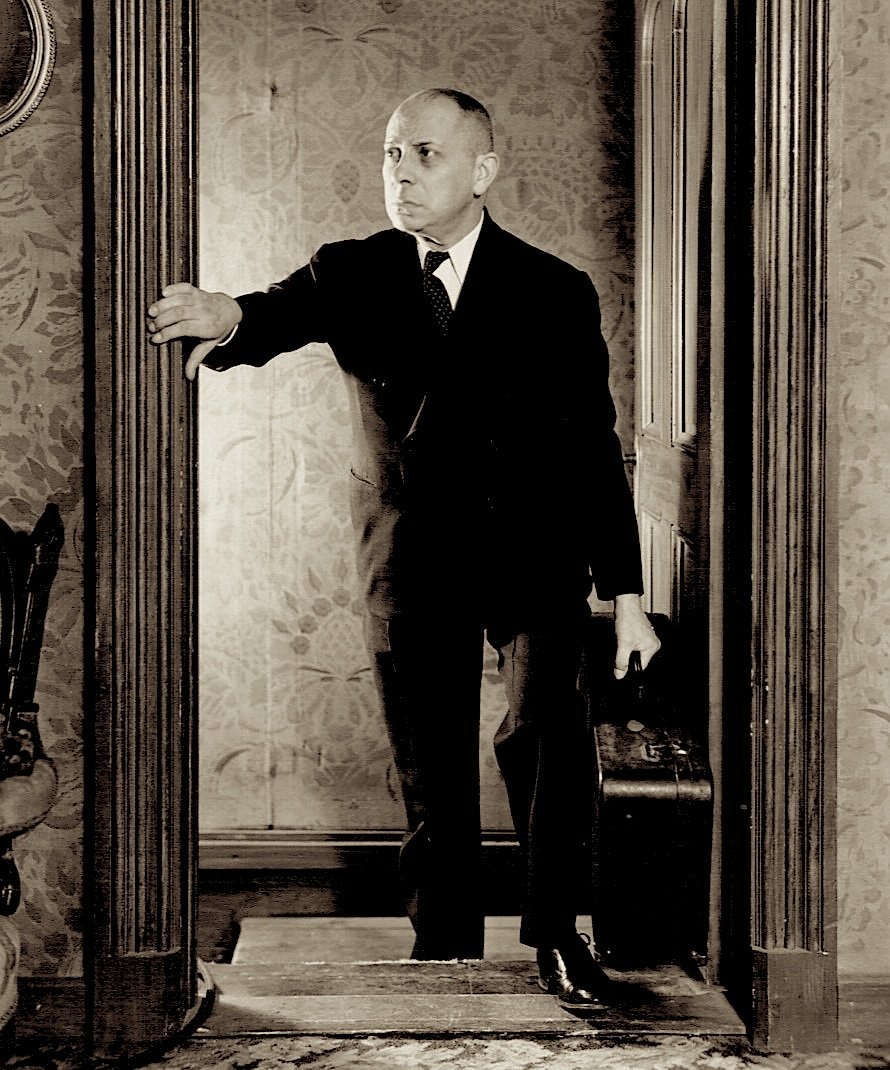
Wilder, a longtime admirer, casts him as Field Marshal Rommel in Five Graves to Cairo.
As Max von Mayerling - the silent-era director turned butler to Gloria Swanson’s Norma Desmond - he plays a role close to his own life. It was his idea to use real footage from Queen Kelly. He is nominated for an Academy Award.
Weeks after receiving the Légion d’honneur in March 1957 - too ill to leave his bed - he dies at his home in France, aged 71, revered there as an uncompromising genius of the cinema.
The full research timeline: open it ↗
Tony-nominated composer and pianist Wayne Barker accompanies the film live - the way silent films were meant to be seen.

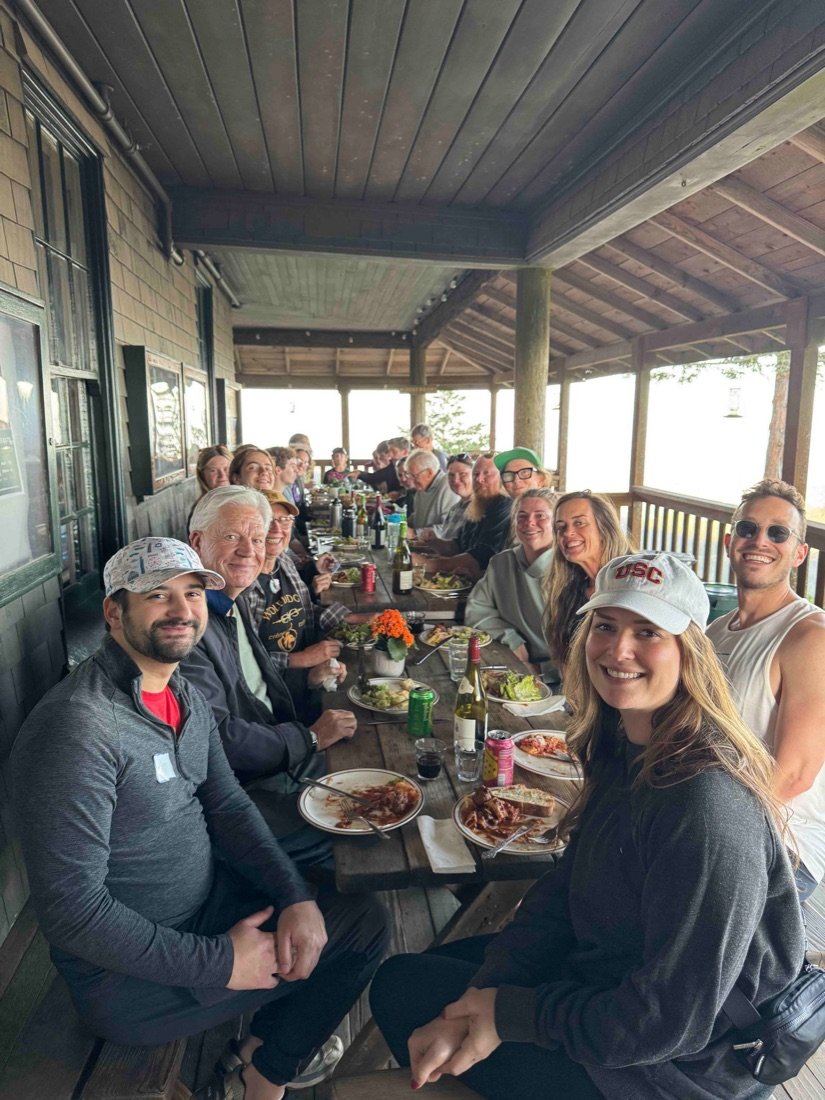
The rustic alpine lodge on Mt Tamalpais. Two screenings, at 4:30 pm and 7:00 pm - doors open at 4:00 pm and 6:30 pm. BYOB - wine welcome.
$30 per person, reserved ticketing through Zeffy. Club discounts are available - for those, or any questions, email events@westpointinn.com.

Doors open at 4:00 pm and 6:30 pm; the film starts at 4:30 pm and 7:00 pm. Allow extra time on the winding Panoramic Highway.
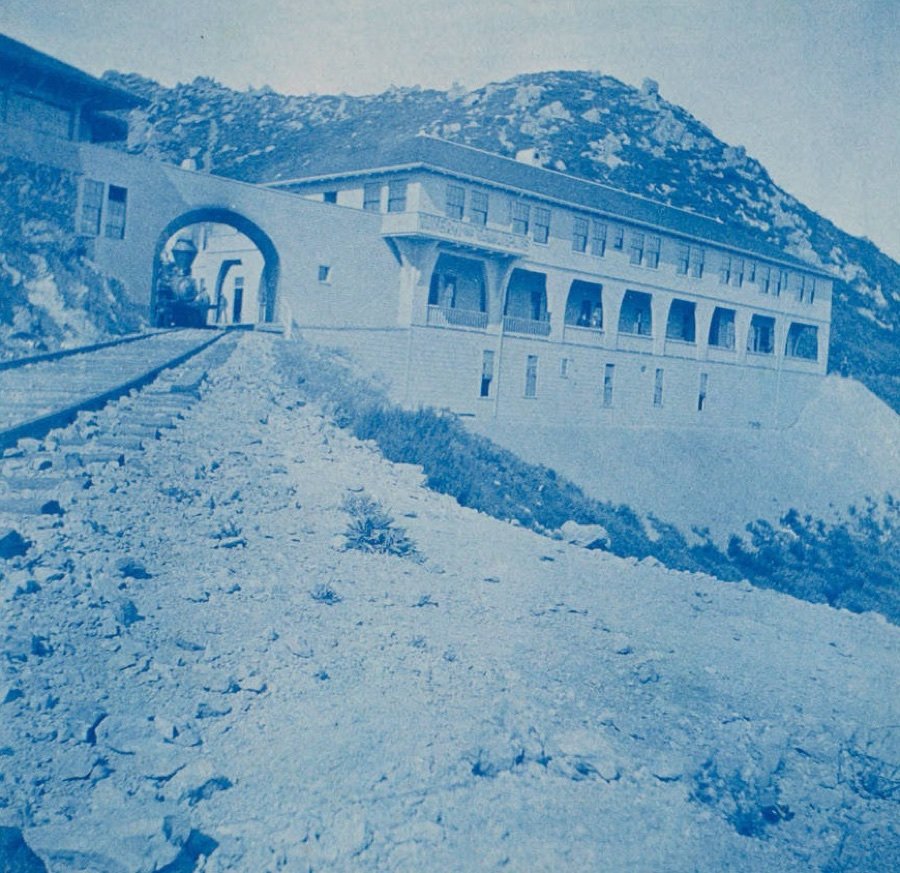
A railway inn at the westernmost curve of “the crookedest railroad in the world” - saved by hikers, volunteers and members, and still welcoming guests on Mt Tamalpais.
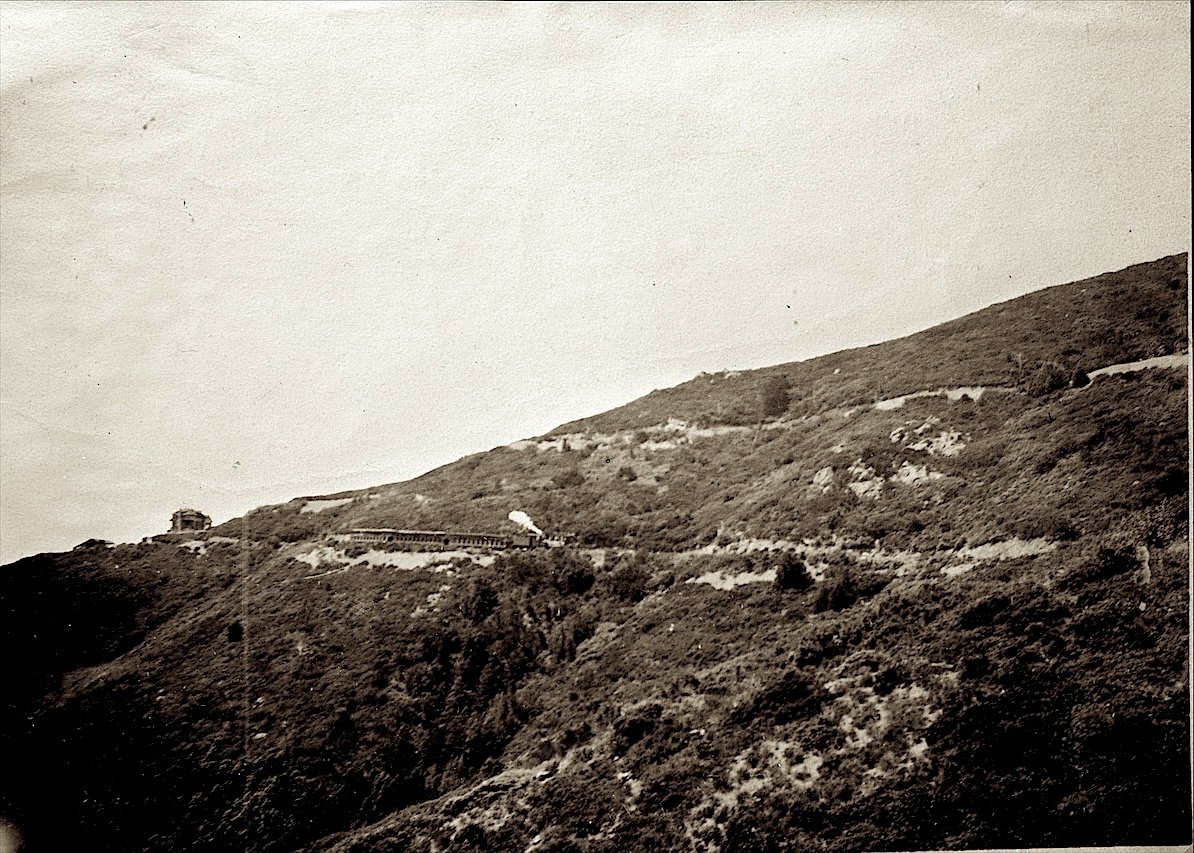
The Mill Valley & Mt. Tamalpais Scenic Railway is built in about six months, largely by hand. The first passenger train reaches the summit on August 22, 1896, and the Tavern of Tamalpais opens near East Peak. On September 16, suffrage leader Susan B. Anthony rides up as the railway’s guest and speaks to two women’s groups at the summit, campaigning for California women’s right to vote.
California Governor James H. Budd rides up with his staff and a party of politicians and spends the night at the Tavern of Tamalpais.
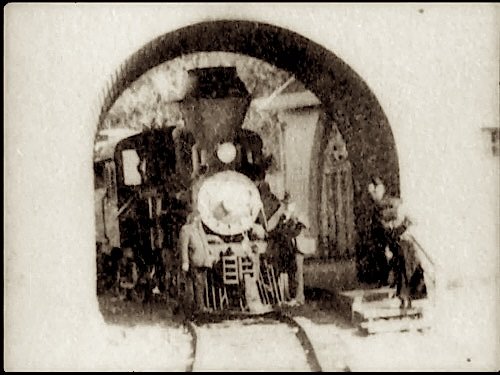
An Edison film crew shoots three short films on the Mt. Tamalpais trains - among the earliest motion pictures made on the mountain. The films survive at the Library of Congress.
The author rides to the summit at least twice around 1900–01, and photographs the Tavern and an open railway car with his own camera. He later opens his 1904 novel The Sea-Wolf with a summer cottage “in Mill Valley, under the shadow of Mount Tamalpais.”
The railroad builds a stage road - today’s Old Stage Road - from West Point to Willow Camp, now Stinson Beach.
Built by the railway for about $2,500 (about $90,000 today) at West Point, the line’s westernmost curve, where trains met the stages to Willow Camp and Bolinas. Railway president Sidney B. Cushing asked for it.
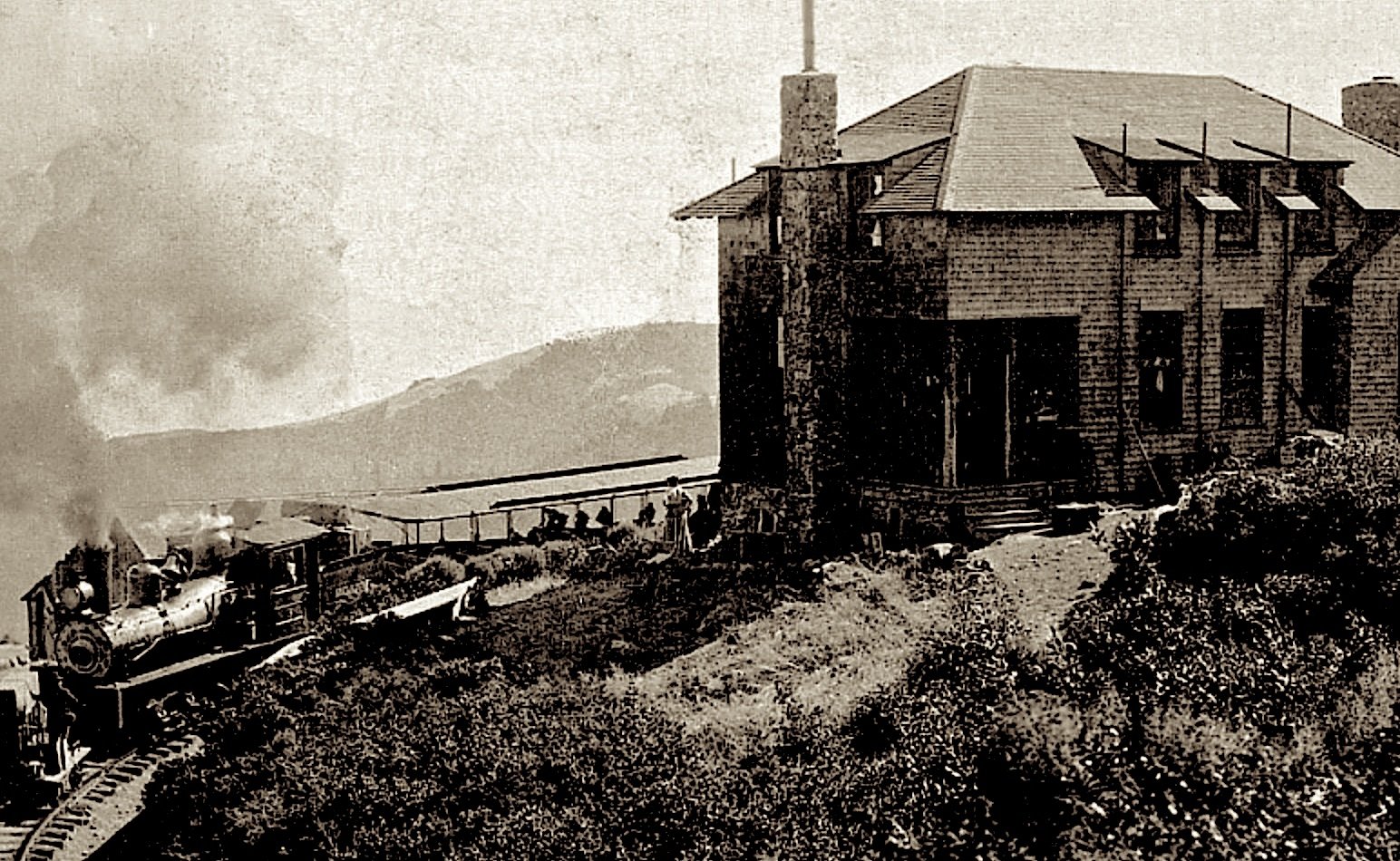
A one-mile commuter service starts up Blithedale Canyon on the mountain railway’s own track - 8 minutes from Lee Street to the Mill Valley depot for 5¢ (about $1.75 today; later 10¢, about $3), in single cars nicknamed “the Black Maria,” “Dinky” and the “Kissel Kar.” It ran until 1927, when riders had fallen to about half what they were in 1921.
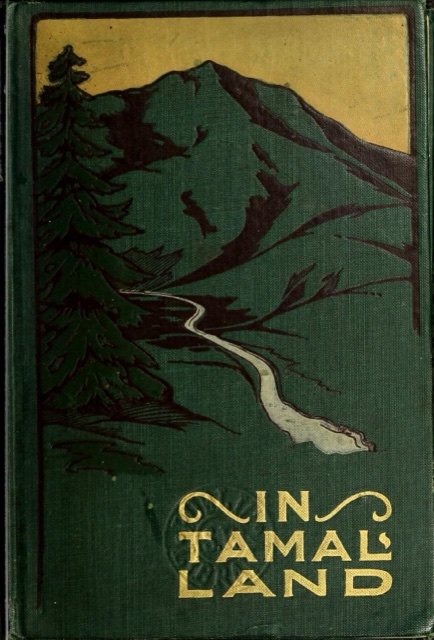 Helen Bingham, In Tamal Land, 1906
In her book In Tamal Land, Helen Bingham rides the train up past the “double bow-knot,” “stopping a few moments at West Point, where passengers for Bolinas take the stage.” Coming back down, she writes, “we alighted and after lunching at the Inn, mounted the stage which was bound for Bolinas” - then on by steam-launch across the Bolinas Lagoon.
A branch line runs down into Redwood Canyon, carrying the first tourists to Muir Woods by rail - a national monument from 1908. Among the first was the naturalist John Muir himself. William and Elizabeth Kent had bought the canyon in 1905 to save its redwoods, gave it to the nation, and asked that it be named for Muir.
The railway’s first president dies. Son of Blithedale’s founder, Dr. John Cushing, he had turned Blithedale into Mill Valley’s first hotel, led the building of the line in 1896, and asked for the West Point Inn in 1904. William Kent called him the man who first taught him that the mountain was too good to be privately owned.
A “Beautiful California” postcard, posted in Oakland on April 2, 1911, shows the Inn hung with American flags and a crowd of visitors sitting out front.
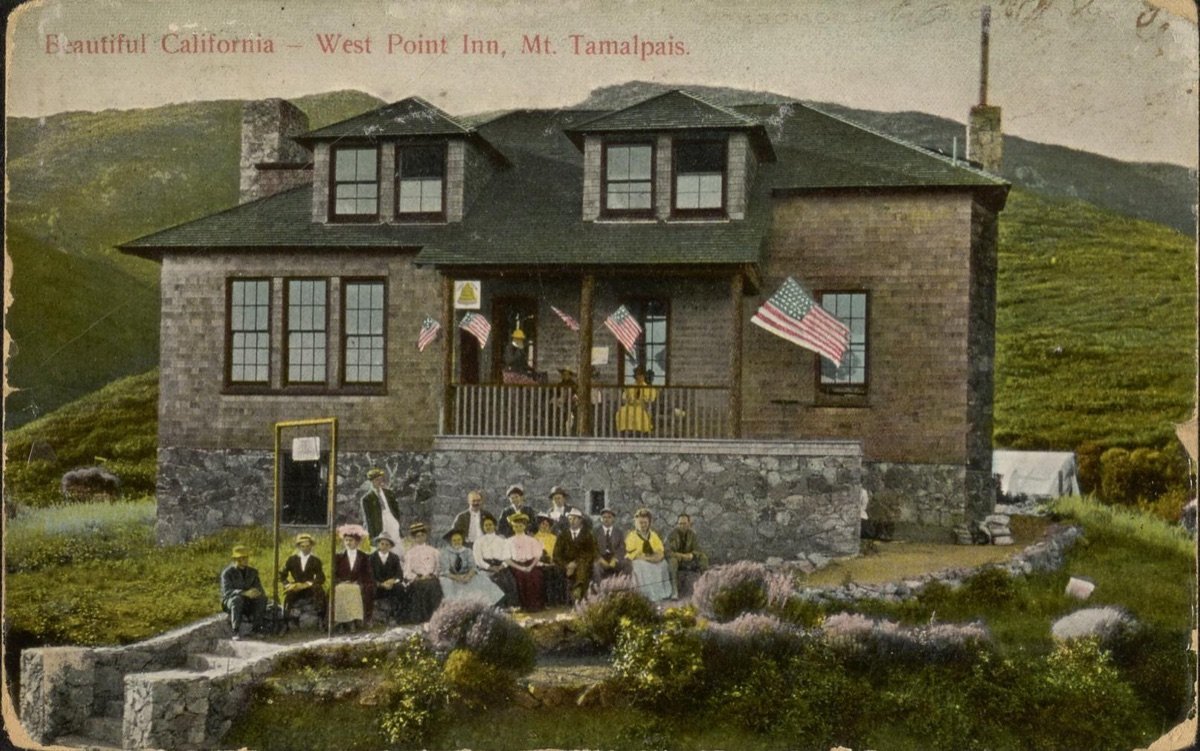
Voters create the Marin Municipal Water District, which takes over the land under the Inn. The new Tamalpais Conservation Club makes the Inn its hiking headquarters. And Erich Stroheim arrives to wait on tables.
Garnet Holme stages Abraham and Isaac in a natural amphitheater about two miles from the Inn. Cast and crew lodge at West Point, and the railway adds a siding for playgoers.
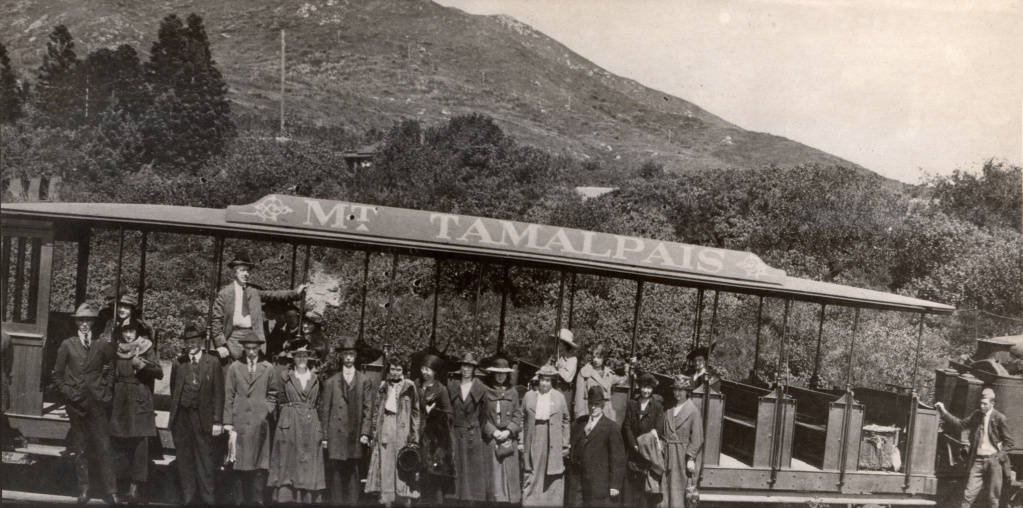
Stagecoach service to Willow Camp and Bolinas ends, and the Inn closes for a time - in the railroad’s busiest year, during San Francisco’s Panama-Pacific Exposition.
Congressman William Kent, who gave Muir Woods to the nation, takes fellow congressmen and their families up by train and down by gravity car to a barbecue in Muir Woods. He called railway president Sidney Cushing “the man who first taught me this mountain is too good a thing to be” in private hands. That year the Kents gave the land for the Mountain Theater - the Sidney B. Cushing Memorial Theater. A congressional party of about 250 that visited the Tavern in 1915 included Assistant Secretary of the Navy Franklin D. Roosevelt, Vice President Thomas R. Marshall and former House Speaker “Uncle Joe” Cannon.
Led by the Tamalpais Conservation Club, the Inn reopens with an enlarged porch - the one guests still enjoy. Small cabins are added around this time.
Dr. Washington Dodge of San Francisco - a survivor of the Titanic - builds the most finely crafted of the Inn’s cabins.
Six years after waiting tables here, Erich von Stroheim plays a cruel, monocled Prussian officer in D. W. Griffith’s Hearts of the World - the screen villain that makes his name.
Universal releases Blind Husbands, Stroheim’s first film as a director, from his own script The Pinnacle - possibly drawn from his days at the Inn: a love triangle at a mountain resort, with a struggle for life on a peak. Planned at about $42,000 (about $790,000 today), it takes about $1 million (about $19 million today).
An 800-square-foot dining room is added to the back of the Inn. It later becomes the Rec Room, and today it is the Members’ Lounge.
Stroheim’s second film, a drama of Paris society. No copy is known to survive.
Stroheim directs and stars as a false count preying on rich visitors to Monaco, with Monte Carlo built twice - at Universal City and on the cliffs at Point Lobos. Universal bills it as “the first real million dollar picture” (about $19 million today).
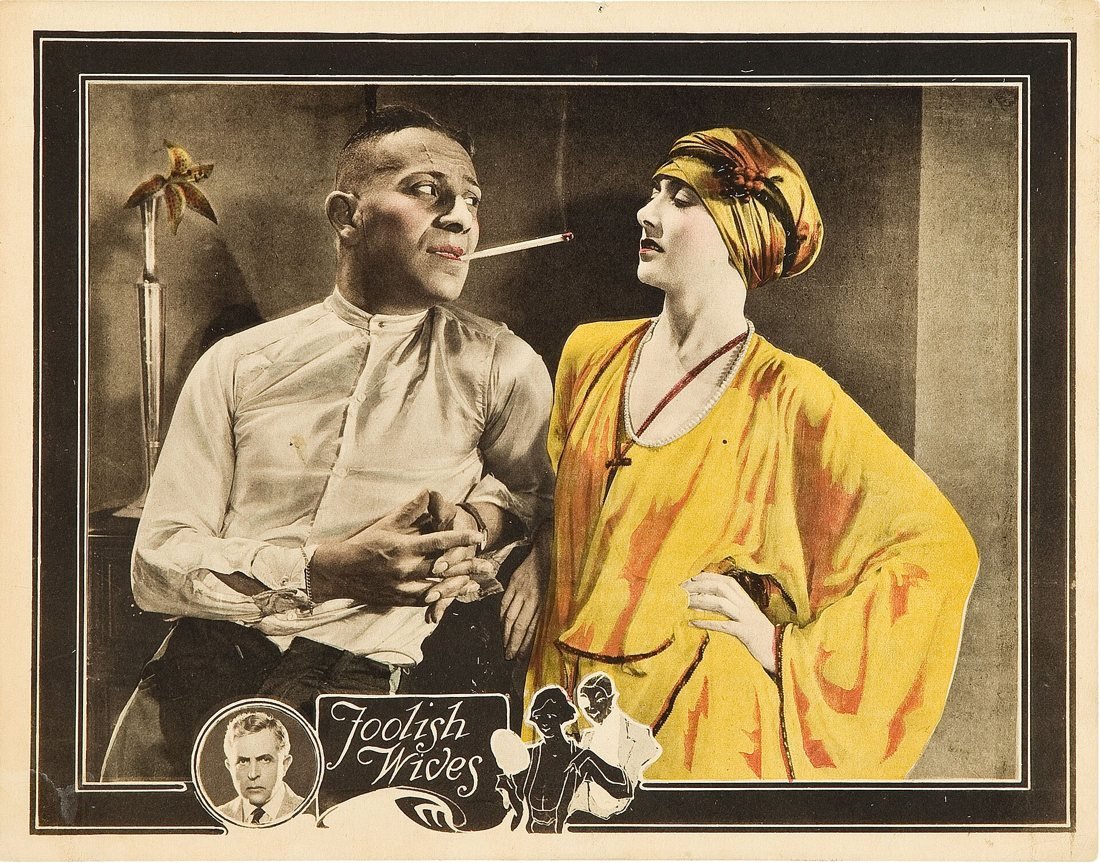
The creator of Sherlock Holmes rides to the summit with his family and coasts down to Muir Woods by gravity car. “In all our wanderings,” he writes, “we have never had a more glorious experience.” Weeks later, on June 30, a brush fire burns the 35-room Tavern - owned by William Kent, the railway’s chief stockholder - while about 50 visiting doctors are on the mountain; a special train brings everyone down.
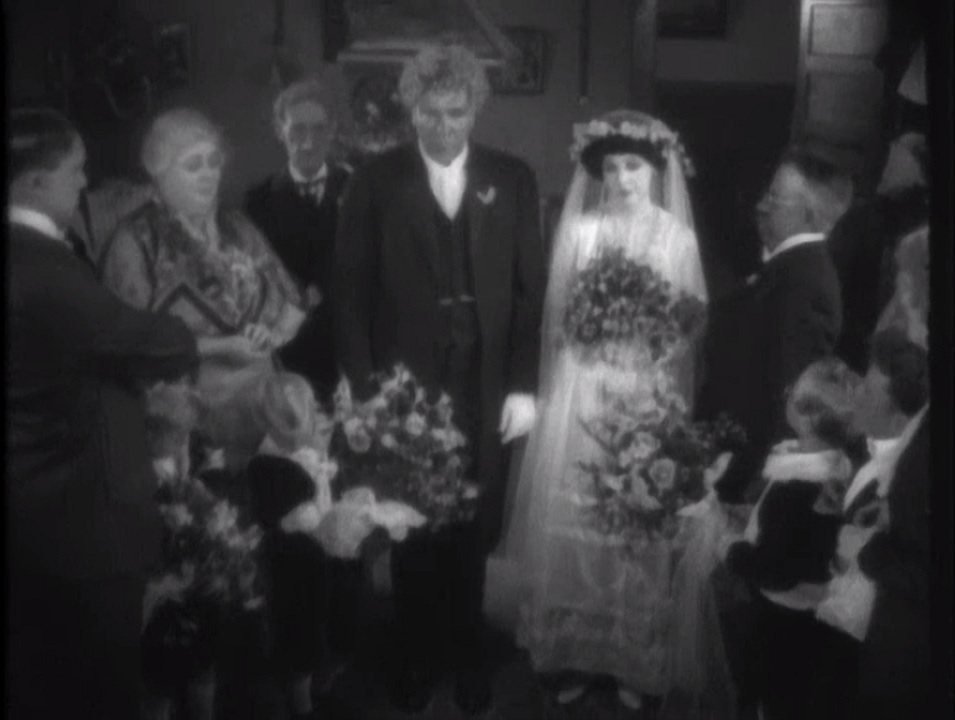
Partway through filming his romance of old Vienna, Universal’s Irving Thalberg fires Stroheim; Rupert Julian finishes the film. That year Stroheim is back in the Bay Area, filming Greed.
His masterpiece, from Frank Norris’s McTeague, filmed in San Francisco and Death Valley. His first cut runs about nine hours; MGM cuts it to about two and a half, and the rest is lost.
For MGM, with Mae Murray and John Gilbert - Stroheim’s most commercially successful film.
Mount Tamalpais State Park is created, its lands practically surrounding the Inn. William Kent dies in Kentfield in March 1928. The Mountain Play brings crowds to post-play dinners, and its directors and actors lodge at the Inn while they rehearse.
Stroheim directs and stars as a Viennese prince, with Fay Wray and ZaSu Pitts.
In July the Great Fire sweeps the south side of the mountain into Mill Valley; the Inn survives. Cars have drawn riders away, and the last train runs on October 31. The roadbed becomes today’s Old Railroad Grade.
Stroheim is dismissed from Gloria Swanson’s Queen Kelly, which is never finished - and makes his talking-picture debut as an actor in The Great Gabbo.
The railway goes out of business and tears up its rails, leaving the roadbed as a trail. The Inn passes to the water district and innkeepers lease it, keeping it open through the Depression. Thousands of hikers arrive every weekend by train and ferry - 48¢ round trip (about $9 today) - and it was said they sounded like an army marching through Mill Valley.
In its 33 years the railway had carried, by a cautious estimate, well over a million passengers.
The studio reworks his Walking Down Broadway and releases it as Hello, Sister! without his credit. He never directs again.
A Civilian Conservation Corps plan of the Inn shows water-system work, fire breaks and retaining walls. The Works Progress Administration worked here too: in 1980 a note turned up inside a wall - “Old Men’s Bathroom: WPA Project # 50-12069.”
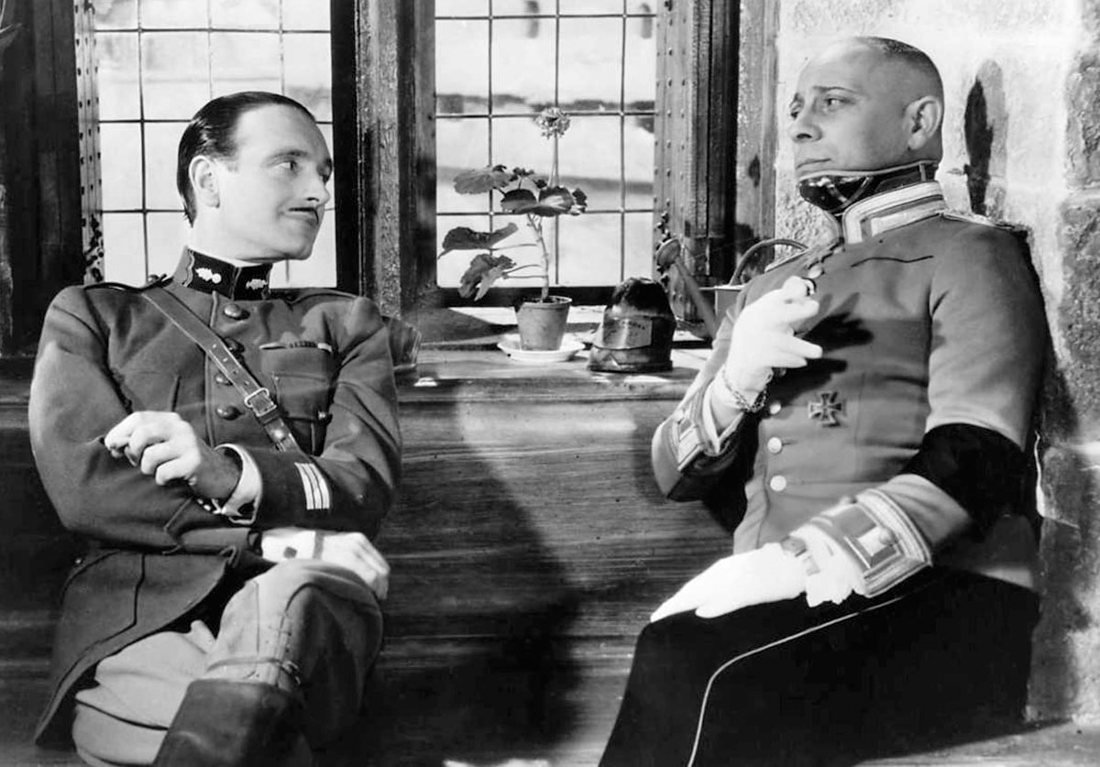
Stroheim plays the aristocratic commandant Captain von Rauffenstein for Jean Renoir - a film nominated for the Academy Award for Best Picture.
The overnight rate, dinner and breakfast included, is $2.75 - about $55 today. During the wartime Army occupation of Mt. Tamalpais, soldiers live at the Inn and many relax here off duty.
Early in the year the Inn’s operators announce they are going out of business, and the building is nearly razed as a fire hazard. Marin hikers protest, and the Sierra Club’s Bay Chapter agrees to sponsor the Inn “for the duration” of the war, selling $5 “interests” (about $95 today) in it to keep it going.
On May 23 the hikers who paid for its equipment form the West Point Club, to run it as a serve-yourself camp open to everyone - and in June, with wartime driving cut back, capacity crowds come for the opening. The club leases the grounds for a dollar a year and runs the Inn with volunteers. Membership cost $5 to join and $2 a year (about $95 and $37 today) - and a room was $1 a night (about $19).
Playing Rommel in Billy Wilder’s Five Graves to Cairo. Wilder: “You were ten years ahead of your time.” Stroheim: “Twenty.”
Run by its members, the West Point Inn is once again open all year round.
As Max von Mayerling, Norma Desmond’s butler - once her director and her husband - Stroheim is nominated for the Academy Award for Best Supporting Actor.
A Sierra Club newsletter describes the Inn: five cabins and seven rooms, run cooperatively by the West Point Club with Al Duhme as manager and volunteer hosts at weekends. A night costs $1.75 (about $22 today), or $1.25 (about $16) for members, with use of the kitchen to cook your own meals. Sheets rent for 35¢ (about $4.30 today) and pillowcases for 15¢ (about $1.85) - and anyone is welcome to use the porches and tables.
Weeks after receiving France’s Légion d’honneur, Stroheim dies at his château near Paris, aged 71 - forty-five years after waiting tables at the West Point Inn.
With little maintenance done on the 70-year-old building, the Inn is looking dilapidated - and the water district considers the club too exclusive. Change is coming.
The Sierra Club’s Marin group plans a party at the Inn to watch Comet Kohoutek - and gets the worst night in years, with snow, rain and gales. Of 235 people booked, about 75 mountain veterans make it in, to bowls of chowder and borscht and an astronomer’s slides of the comet, run off a rented generator, since the Inn has no electricity. At 9:30 a woman walks in, having hiked up alone from Mill Valley through the storm.
The West Point Club becomes the nonprofit West Point Inn Association, set on restoring the aging buildings. New bylaws are drawn up at the water district’s direction, restoration toward the old 1890s look begins, and porch display cases of the mountain’s rocks, birds and flowers are added, with a National Park Service display on the old railway and inns.
Christmas at the Inn becomes a tradition: a Swedish dinner and Santa Lucia breakfast in 1975, then from 1978 to 1980 a “mini-Bracebridge” dinner by gaslight, with College of Marin madrigal singers carrying in a boar’s head.
The Pancake Breakfasts begin - the idea of Pete Martin of the Mt. Tamalpais fire station, a railway history buff, to pay for the Inn’s upkeep, at $2.50 (about $8 today) for all you can eat. Hikers have been climbing the mountain for them ever since, on summer Sundays.
Longtime volunteer Mary King and a friend, both in their seventies, go up to take down the Christmas decorations - and are stranded for four days as the storm washes out all three fire roads. With no electricity and the phone line on and off, they live on weekend leftovers until the caretaker and a water district ranger reach them, throwing rocks into a washout until their four-wheel drive can cross. Afterwards the lodge and all five cabins get new roofs, with matching funds from the Buck Fund, alongside a new fire line, septic system and beds.
In 1982 a paid caretaker, Ed Conaway, runs the Inn on weekdays and volunteers take the weekends. Up to 30 guests stay overnight with their own sleeping bags and flashlights, and the Association has about 175 to 200 members, paying dues of $35 a year (about $115 today), or $50 (about $165) for a couple.
The Association adds innkeepers’ quarters behind the Members’ Lounge, designed to match the old Inn. The porch is rebuilt and oak floors laid.
Members improve the septic system, put a foundation under the 1918 Honeymoon Cabin, re-shingle and strengthen the other cabins, and restore the Members’ Lounge windows (1998). A long wooden ramp makes the porch and Cabin 1 accessible to people with disabilities.
The Inn celebrates its centennial with a party for all comers: live John Philip Sousa music, period costumes, a barbecue lunch, hikes - and a horse-drawn stagecoach back at West Point.
A small “solar shed” is built beside the Inn. The kitchen is upgraded, safety features added and hazard trees removed - and the monthly summer pancake breakfasts carry on.
The West Point Inn is listed on the National Register of Historic Places - a rare surviving Bay Area rustic mountain lodge, and the last surviving building of the mountain railway.
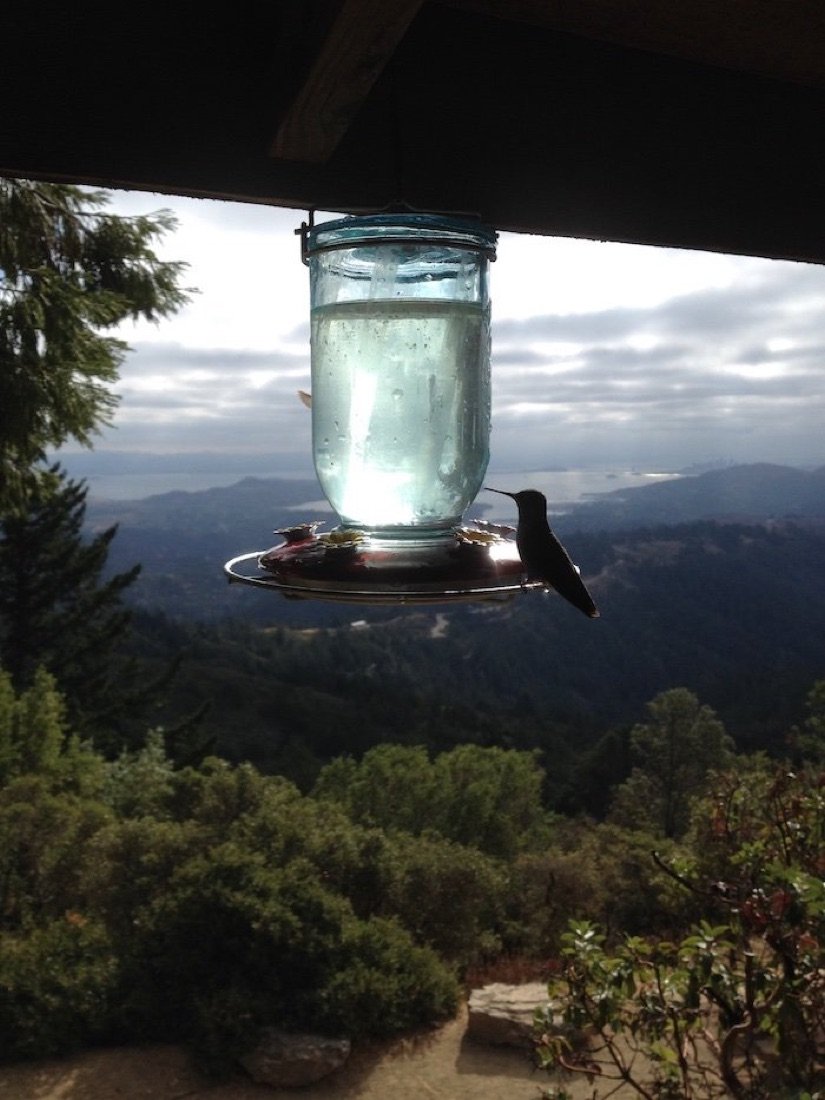
Made possible by a generous donation from the Ernest E. Emig Trust, a purpose-built accessible cabin opens, with a roll-in shower, a small porch and an accessible path to van parking. Its walls are lined with reclaimed wood from the water district’s old water towers - and unlike the rest of the Inn, it has power, heat and hot water.
Ernest E. Emig spent a vast portion of his life hiking the trails of Mt. Tamalpais, year after year.


Fred Runner, the Inn’s historian, wins the auction for Engine No. 9 - the last surviving locomotive of the mountain railway - to restore it and bring it back to Marin.
The pandemic closes the Inn and freezes its income. With a shared kitchen and bathrooms, it doesn’t fit the county’s reopening rules for hotels, and the volunteer board draws on its reserves to keep the place maintained. Longtime innkeeper David Durr launches a GoFundMe to help it reopen safely.
Outside magazine names the West Point Inn among “The Best 25 Winter Trips in the World.”
A remarkable snowfall blankets Mt. Tamalpais and the Inn, with the innkeepers on hand to look after it.
The West Point Inn Association starts a Capital Improvement Fund, for the larger pieces of work - beyond everyday upkeep - that keep the Inn sound and welcoming for the next hundred years. Gifts go straight to the current project; when it is done, the fund moves on to the next. The first: improving the deck and removing the ramp.
By late October the Inn had 2,251 room bookings for 2026 - about 2,585 room-nights and some 4,800 guests, with 46 whole-Inn bookings. July was the busiest month, then April and August, and Saturday the busiest night. The most-booked was Cabin 9 (224 nights), then Cabin 8 “Toby” and Cabin 11, and the accessible Emig Cabin was booked for 166 nights.
The West Point Inn Association presents Blind Husbands - the film inspired by the young man who waited on our tables in 1912 - as a fundraiser for the Inn.
Sources include the Inn’s historical files kept by Fred Runner, the Inn’s historian; the Sierra Club’s Yodeler newsletters, 1943–1951; Mary King’s 1982 oral history and other material in the Anne T. Kent California Room, Marin County Free Library; the Mill Valley Public Library; the Inn’s National Register nomination (California State Parks); westpointinn.com; Friends of Mt. Tam; the National Park Service; the Marin Municipal Water District; BORP; the Mill Valley Chamber of Commerce; and SFGate.